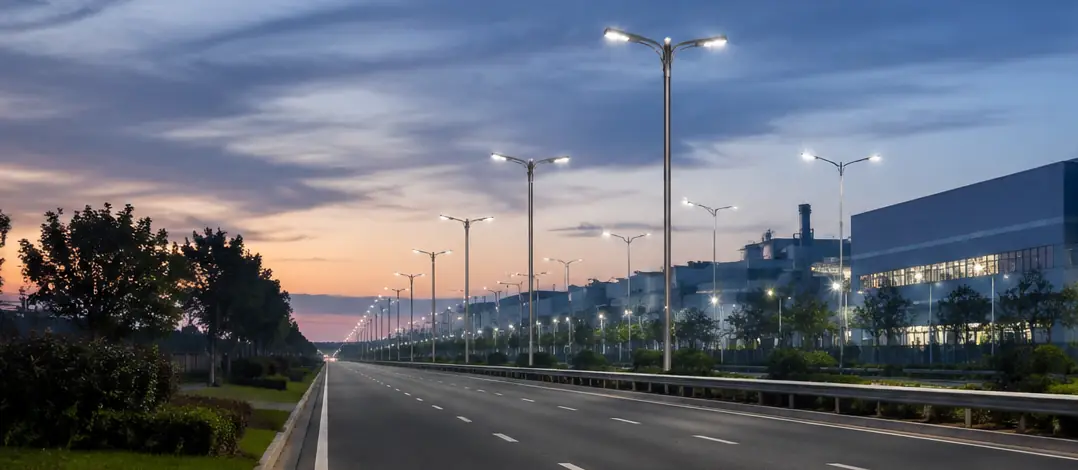
High-mast lighting RFQ guide
High-Mast Lighting Poles: What to Confirm Before RFQ
A high-mast RFQ starts with the complete lighting assembly and the site where it will be installed and maintained. Send the layout, luminaire schedule, mounting concept, access approach, known site inputs and foundation status—not a height alone.
This buyer guide does not establish lighting performance, structural capacity, foundation design, maintenance procedures or project approvals.
The short answer: describe the whole assembly
A high-mast installation brings together a pole, mounting ring or crossarm arrangement, luminaires, electrical/control components, a base or foundation interface and a maintenance plan. A useful enquiry identifies that assembly and shows which decisions are still open.
FHWA lighting and ancillary-structure references describe lighting infrastructure in site and equipment context. That is a practical reason to connect the lighting layout, mounted equipment, access and civil interface before a quotation is treated as final.
Lighting layout
Application, pole locations, areas to be lit, mounting direction, nearby obstacles, aiming constraints and the latest drawing available.
Mounted equipment
Luminaire model or stated selection status, quantity, ring/crossarm geometry, attachments, supplied weight or projected-area information and electrical/control interfaces.
Project interfaces
Finished grade, foundation/base status, cable routing, installation and maintenance access, operating constraints and responsible review parties.
What belongs in a high-mast lighting pole RFQ
Early inputs can be incomplete. The important procurement step is to state what is known, label what remains open and identify the review path instead of embedding unconfirmed assumptions in a quote.
| Application and layout | Airport-side, port, yard, interchange, sports venue, industrial area or other application; provide pole locations, target areas, obstructions, aiming constraints and drawings when available. |
|---|---|
| Mounting concept | Proposed mounting height, pole preference if any, ring/crossarm arrangement, equipment orientation, handhole direction and finished-grade/base information. |
| Luminaire schedule | Datasheets or stated selection status, quantity per pole, mounting arrangement, supplied weights, projected-area/EPA data where available, aiming responsibility and cable/control notes. |
| Site and environmental input | Location, exposure, project-supplied wind/design information, corrosion/finish preference, environmental conditions and crane/lift or operating restrictions. |
| Foundation interface | New or existing foundation, civil drawings, base/anchor information when known, cable entry and the party responsible for foundation design and installation. |
| Access and maintenance | Installation route, work area, intended service approach, traffic or operating controls, electrical isolation responsibility and maintenance ownership. |
| Review and release scope | Budget or formal quotation stage, drawing/submittal needs, designated structural/electrical/civil review parties, authority requirements and production-release conditions. |
Why the lighting ring and luminaire schedule matter
The mounted equipment changes the procurement conversation. The number of luminaires, their arrangement, the mounting geometry and any supplier-provided weight or projected-area data are inputs to the overall assembly being reviewed. If a fixture choice is not final, label it as open.
Do not substitute a photograph, a generic wattage or a previous-project reference for an equipment schedule. Send the actual datasheet when available, or state the expected arrangement and the party who will confirm it.
Make maintenance access an explicit RFQ input
The chosen service approach can affect the project discussion. State whether the project is considering a lowering arrangement, ground-access equipment, elevated access equipment or another method, together with site work-zone and operating constraints.
This guide does not select the maintenance method. It makes the access decision visible so equipment, site restrictions and responsible review parties can be coordinated before release.
Access concept
State the intended installation and service approach, available working area, operating restrictions and any required coordination with site operations.
Equipment configuration
Identify whether the luminaire/ring arrangement, cable/control interfaces or other components affect the intended service concept.
Review responsibility
Identify the project parties responsible for structural, electrical, safety, civil, maintenance and authority review.
A practical RFQ sequence
Use clear stages to obtain useful early pricing without presenting a concept arrangement as an approved construction configuration.
| 1. Concept or budget | Share the application, approximate layout, proposed height, expected fixture arrangement, site context and known access constraints. Mark unresolved details. |
|---|---|
| 2. Drawing coordination | Align the pole, ring/crossarms, luminaires, base/foundation interface, cable route, access direction, work area and supply boundary. |
| 3. Project review | Confirm the designated lighting, structural, electrical, civil, safety, maintenance and authority review responsibilities and documentation route. |
| 4. Production release | Release only the approved configuration, equipment schedule, interfaces, finish, drawings and agreed submittal/inspection requirements for the contracted scope. |
Common gaps that create rework
A concise unresolved-items list is more valuable than a polished quote built on missing equipment, access or foundation assumptions.
Only a height is supplied
Add the application/layout, luminaire schedule, mounting arrangement, site inputs, foundation status and access concept.
Fixture selection is unclear
Send the datasheet or state that selection remains open; do not use an image as confirmed load or mounting information.
The foundation is assumed
Provide civil drawings, base/anchor information, cable entry details and the project approval path for new or existing work.
Maintenance is deferred
State the intended access approach, work area, operational constraints and electrical isolation responsibility early.
Related guides for the project package
The RFQ package usually needs the lighting layout, wind/load inputs, foundation interface and access discussion connected in one place.
Source references
These public FHWA and U.S. Department of Energy references provide context for lighting infrastructure. They do not replace project-specific lighting, structural, electrical, civil, access, safety or authority requirements.
FAQ
What should a high-mast lighting pole RFQ include?
Include the application and layout, proposed pole locations, mounting concept, luminaire schedule, ring or crossarm arrangement, known projected-area or load information, access approach, site conditions, foundation status, electrical interfaces and the responsible project review parties. Identify open items rather than treating them as fixed assumptions.
Is a proposed mounting height enough for a high-mast pole quotation?
It can begin a budget discussion, but it does not define the full assembly. The lighting equipment, mounting geometry, site and wind inputs, foundation interface, maintenance access and project review scope also need to be stated or marked open.
When should a lowering-system requirement be discussed?
Discuss it early if it is part of the intended maintenance approach. State the proposed access and maintenance concept, equipment arrangement, site working constraints and the parties responsible for final review. Do not assume a lowering arrangement from a generic high-mast description.
Who confirms the final high-mast lighting pole configuration?
The responsible project parties confirm the final configuration through the applicable lighting, structural, electrical, civil, maintenance, safety and authority review process. A preliminary quotation or buyer guide does not replace that review.
Send a High-Mast Lighting Pole RFQ
Send the site/layout drawing, proposed mounting concept, luminaire and ring/crossarm schedule, known load or projected-area information, access constraints, foundation status, electrical/control notes and required review stage. Mark open items clearly.
Leave a Reply