RFQ engineering inputs
Wind Load and EPA for Light Poles: What Buyers Should Send Before RFQ
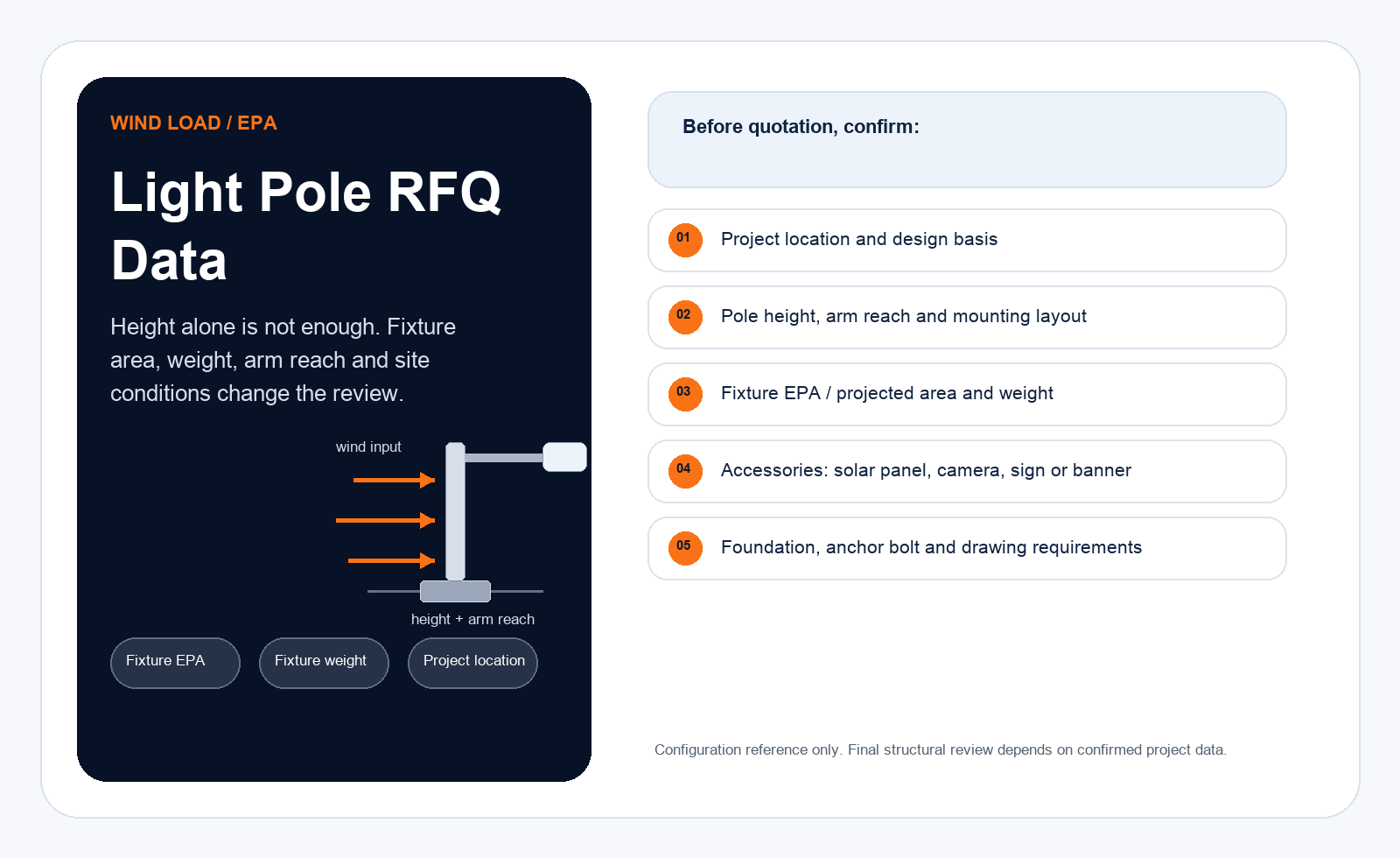
A light pole cannot be reviewed from height alone. Wind load review needs the project location, design basis, mounting height, arm reach, fixture EPA, fixture weight and any accessories attached to the pole.
Use this guide before sending a roadway, sports, solar or multifunctional pole RFQ.

EPA is not the same as fixture weight
EPA is an aerodynamic input. Weight is a gravity load. Both matter, but they answer different engineering questions.
For a light pole RFQ, EPA usually refers to the effective projected area of the luminaire or attached equipment under wind. A heavier fixture is not always the largest wind-area problem, and a light fixture with a broad housing can still create a meaningful wind input.
EPA / projected area
Helps review wind effect from luminaires, solar panels, cameras, signs or other attached equipment.
Fixture weight
Helps review supported load, arm behavior, handling assumptions and connection details.
Mounting geometry
Arm reach, tilt angle, bracket position and fixture quantity can change the same pole height into a different review case.
Why wind load cannot be promised from height alone
A common inquiry says: “Can this 10 m pole withstand 150 km/h wind?” That question is incomplete. The answer depends on the design basis, site exposure, pole shape, material, arm layout, foundation assumptions and the equipment mounted at the top.
Official lighting and structural support references separate roadway lighting planning from structural design inputs. In practical RFQ work, that means the buyer should send the lighting layout and fixture data before expecting a firm pole configuration.
| Project location | Country, city and site type help identify environmental and design assumptions for review. |
|---|---|
| Design basis | Local code, client standard, basic wind speed definition or project specification if already available. |
| Pole height | Mounting height, total shaft height and whether the pole is straight, tapered, round or polygonal. |
| Arm reach | Single arm, double arm, bracket length, bracket angle and fixture offset from the pole centerline. |
| Fixture data | Model, quantity, weight, EPA or projected area, mounting angle and datasheet. |
| Extra equipment | Solar panel, battery box, camera, sign, banner, antenna, speaker or decorative parts. |
| Foundation assumptions | Base plate, anchor bolts, embedded section, civil drawing or whether foundation design is excluded. |
What to send before requesting a wind / EPA quotation
The fastest RFQ is not the shortest email. It is the email that removes the largest assumptions. If the buyer does not know every item, mark the unknown fields clearly so the supplier can quote a preliminary configuration instead of guessing silently.
| Required first | Project country, application, approximate quantity, pole height, fixture model or drawing, fixture weight and fixture EPA or projected area. |
|---|---|
| Strongly recommended | Arm reach, mounting layout, fixture count per pole, solar panel size, accessory list and site exposure notes. |
| If available | Local design standard, design wind speed basis, soil/foundation notes, civil drawing, layout drawing and lighting calculation. |
| For replacement projects | Photos of existing poles, base plate dimensions, anchor bolt pattern, fixture data and failure or maintenance concerns. |
| For early budgets | State what is unknown. A preliminary budget can be separated from final engineering review. |
Common RFQ mistakes that slow down review
Most delays come from missing fixture data, not from missing pole height. If EPA, fixture weight or arm reach is unknown, the pole configuration may change after review.
Only sending height
A 10 m pole with a compact luminaire is not the same as a 10 m pole with long arms, large fixtures or signs.
Mixing accessories later
Solar panels, cameras, signs and banners can change wind area and connection assumptions.
Using one site for all sites
A pole reviewed for one region should not automatically be copied to another location without checking local requirements.
Ignoring arm reach
Longer arm reach can affect the review even when the luminaire and pole height are unchanged.
No fixture datasheet
A product photo is not enough. Send weight, dimensions, mounting method and EPA or projected area when available.
Treating quotation as approval
A quotation should state assumptions. Final acceptance still depends on confirmed drawings and project review.
How Fortune Light Pole handles wind / EPA discussion
Fortune Light Pole treats wind load and EPA as project inputs, not as a generic public promise. We can prepare a configuration direction from the buyer’s RFQ data, then refine the pole, arm, base plate, anchor bolt and finish assumptions after the project details are confirmed.
For public website content, we avoid hard wind-resistance claims because real projects depend on local design basis, fixture selection, mounting geometry and installation conditions.
Configuration review
We review height, arm, material, finish, fixture data and accessories together.
Visible assumptions
Unknown data should be marked in the quotation rather than hidden behind a generic model.
Drawing support
When required, project drawings can be reviewed against confirmed dimensions and equipment loads.
Helpful source references
These references help buyers understand why lighting, structural support and wind-load information should be separated and clearly named before quotation.
Related pages
Continue from wind / EPA data to product family selection and RFQ preparation.
FAQ
Is EPA the same as fixture weight?
No. EPA describes wind-area behavior, while fixture weight describes supported mass. A useful RFQ should include both when available.
Can a supplier quote without EPA?
A preliminary quotation may be possible, but the supplier should state assumptions. Final pole configuration should be reviewed after fixture EPA or projected area is confirmed.
Is wind speed enough for light pole review?
No. Wind speed is only one input. The review also needs design basis, exposure, pole height, arm reach, fixture data and any accessories.
Should foundation details be included in the RFQ?
Yes, if available. Base plate, anchor bolt and foundation assumptions affect the project discussion, even when civil design is handled separately.
Send a Wind Load / EPA RFQ
Share the project location, design wind requirement if known, pole height, arm reach, fixture datasheet, EPA or projected area, fixture weight, accessory list and drawing requirement. We will review the configuration with the confirmed project inputs.
Leave a Reply