Installation-interface RFQ guide
Direct-Burial vs Base-Plate Light Poles: What to Confirm Before RFQ
Choose the RFQ path by describing the installation interface—not by assuming every light pole uses the same foundation or below-grade arrangement. State what is known about grade, civil work, equipment and review responsibility.
This is a buyer and engineering-input guide. It does not establish a foundation design, embedment detail, structural capacity, site procedure or approval.

The short answer: describe the interface before selecting a pole
A direct-burial concept and a base-plate concept involve different civil and installation interfaces. Neither should be selected from a product photograph, a nominal height or a past-project reference alone.
The useful first RFQ step is to name the intended interface, attach the available site/civil information and mark unresolved decisions. This lets budget discussions move forward without treating a preliminary assumption as final construction information.
Direct-burial discussion
Proposed location, finished grade, shaft interface below grade, civil/site context, electrical route, access constraints and designated project review parties.
Base-plate discussion
Foundation/base and anchor information when available, grade reference, cable entry, mounted-equipment schedule, access constraints and civil/electrical interfaces.
Shared project inputs
Application layout, pole and bracket configuration, luminaire data, site conditions, corrosion/finish preference, drawings and release responsibilities.
What belongs in the RFQ package
An early enquiry can state open items. The important point is to keep them visible, assigned and outside any unsupported ‘standard’ assumption.
| Application and layout | Roadway, parking area, industrial access road, garden, sports or another application; include pole locations, adjacent uses, available drawings and authority/client requirements. |
|---|---|
| Installation interface | Direct-burial or base-plate concept if known, finished-grade reference, new or existing work, civil status, cable entry and the party responsible for the final installation design. |
| Pole and mounted equipment | Proposed height/shaft preference, arm or bracket arrangement, luminaire selection status, mounting interface, supplied equipment data where available and electrical/control notes. |
| Civil and site context | Soil/site data supplied by the project where available, drainage and grade context, obstructions, utility coordination, access route and installation work-area restrictions. |
| Foundation/base information | For a base-plate concept, send drawings, base/anchor information and cable details when available. For a direct-burial concept, state the civil/design responsibility and any project documents governing the below-grade interface. |
| Review and release scope | Budget or formal quotation stage, drawing/submittal needs, designated structural/civil/electrical reviewers, authority conditions and production-release requirements. |
Do not turn an installation concept into a final design claim
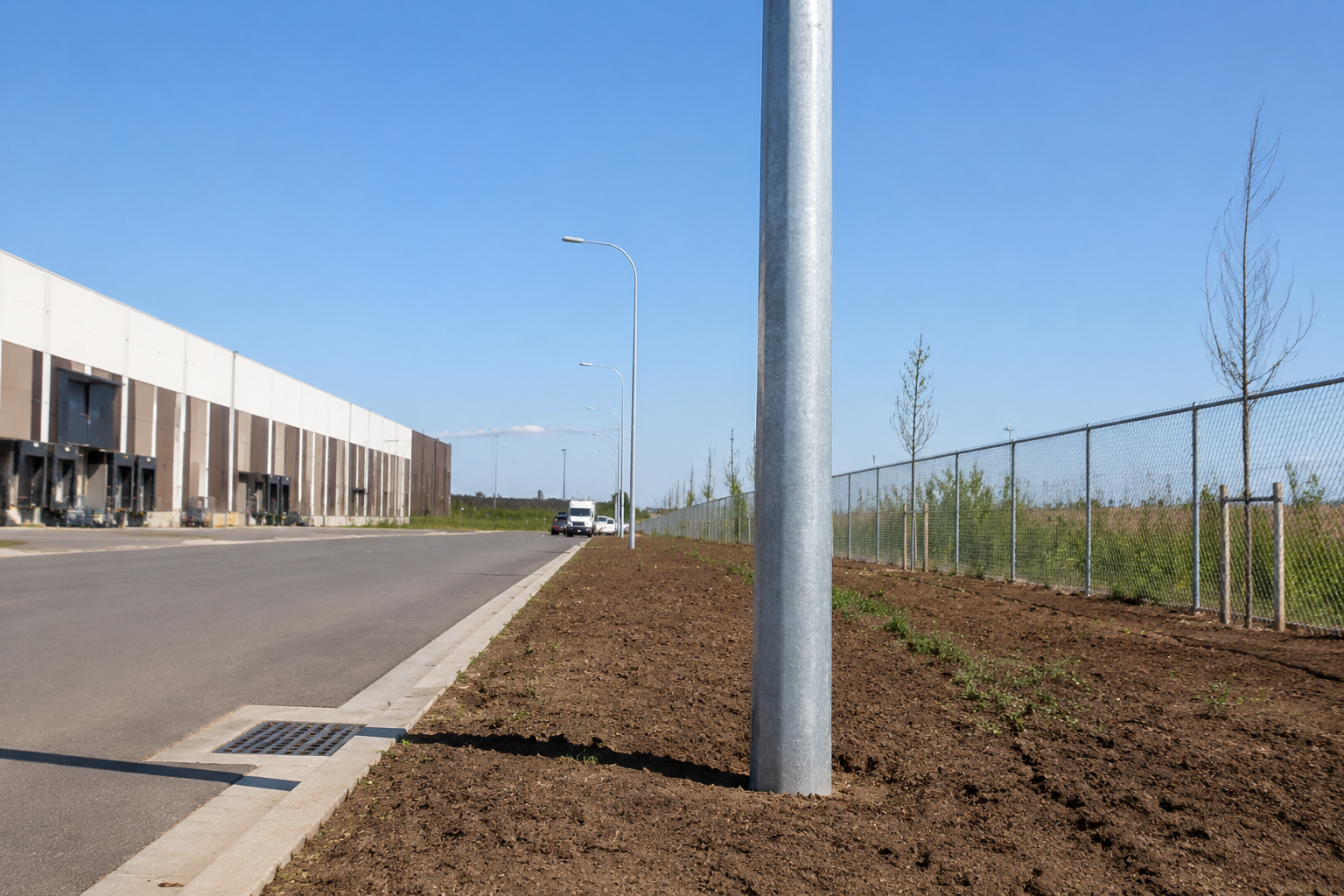
A direct-burial visual may show a pole entering grade; it does not provide a project-specific below-grade detail. A base plate and anchors may be visible on a drawing; they do not by themselves confirm a foundation design, existing-condition suitability or installation procedure.
Keep the design responsibility and available documents visible. A clear RFQ can be specific about the intended interface without substituting generic dimensions for the project’s required review.
A practical RFQ sequence
Use project stages to separate concept pricing from the approved interface.
| 1. Budget or concept | Send application/layout, preferred installation concept, pole/equipment status and the known site or civil context. List open items. |
|---|---|
| 2. Drawing coordination | Align grade, pole location, base or below-grade concept, cable route, mounting equipment, access direction and supply boundaries. |
| 3. Project review | Confirm the responsible structural, civil, electrical, installation, maintenance and authority parties, with the required drawings and documentation. |
| 4. Production release | Release only the approved pole configuration, interfaces, finish, equipment schedule and contracted-scope documents after the designated project confirmation. |
Common gaps that create avoidable rework
A concise unresolved-items list is better than a final-looking quote based on incomplete civil or equipment information.
Only pole height is supplied
Add the layout, intended installation concept, grade reference, equipment schedule, site context and review responsibilities.
Existing foundation is assumed usable
Provide available drawings, measured/base information and the project decision path before relying on reuse.
Direct burial is described without civil scope
State the project-supplied information, design responsibility and required approvals rather than using a generic embedment assumption.
Cable entry and access are omitted
Identify routing, working area, installation constraints and the party responsible for electrical/civil coordination.
Related guides for the project package
Connect the installation interface to the rest of the lighting-pole RFQ package.
Source references
These public FHWA and U.S. Department of Energy references provide general lighting-infrastructure context. They do not replace project-specific structural, civil, electrical, installation, access, safety or authority requirements.
FAQ
What is the difference between a direct-burial and a base-plate light pole?
A direct-burial concept places part of the shaft below grade, while a base-plate concept connects the pole to a foundation and anchor interface. The applicable project documents, site conditions and responsible review parties determine the final installation approach; this is not a universal selection rule.
Can a direct-burial pole be quoted without site information?
A budget discussion can begin with basic application information, but the RFQ should identify the pole location, finished grade, site/civil conditions, luminaire and bracket arrangement, electrical route, access constraints and the responsible project review path. Unknowns should be labeled rather than assumed.
What should be sent for a base-plate light pole RFQ?
Send the available layout and civil information, base/anchor or foundation drawings when known, finished-grade reference, cable entry, equipment schedule, mounting geometry, access conditions and the parties responsible for final civil, structural and electrical review.
Who confirms the final installation interface?
The responsible project parties confirm the final installation interface through applicable structural, civil, electrical, installation, maintenance and authority review. A supplier quotation or buyer guide does not replace those project decisions.
Send an Installation-Interface RFQ
Send the layout, intended direct-burial or base-plate concept, grade/civil information, pole and luminaire schedule, electrical notes, access constraints and required review stage. Mark open items clearly.
What does “direct-bury light pole” mean in an RFQ?
In an RFQ, “direct-bury light pole” usually refers to the direct-burial installation interface rather than a separate universal product class. State the intended interface, available drawings, site conditions, equipment data and unresolved review items so the installation approach is not inferred from height alone.
See the direct-burial street light pole product page for the related configuration discussion.
Leave a Reply