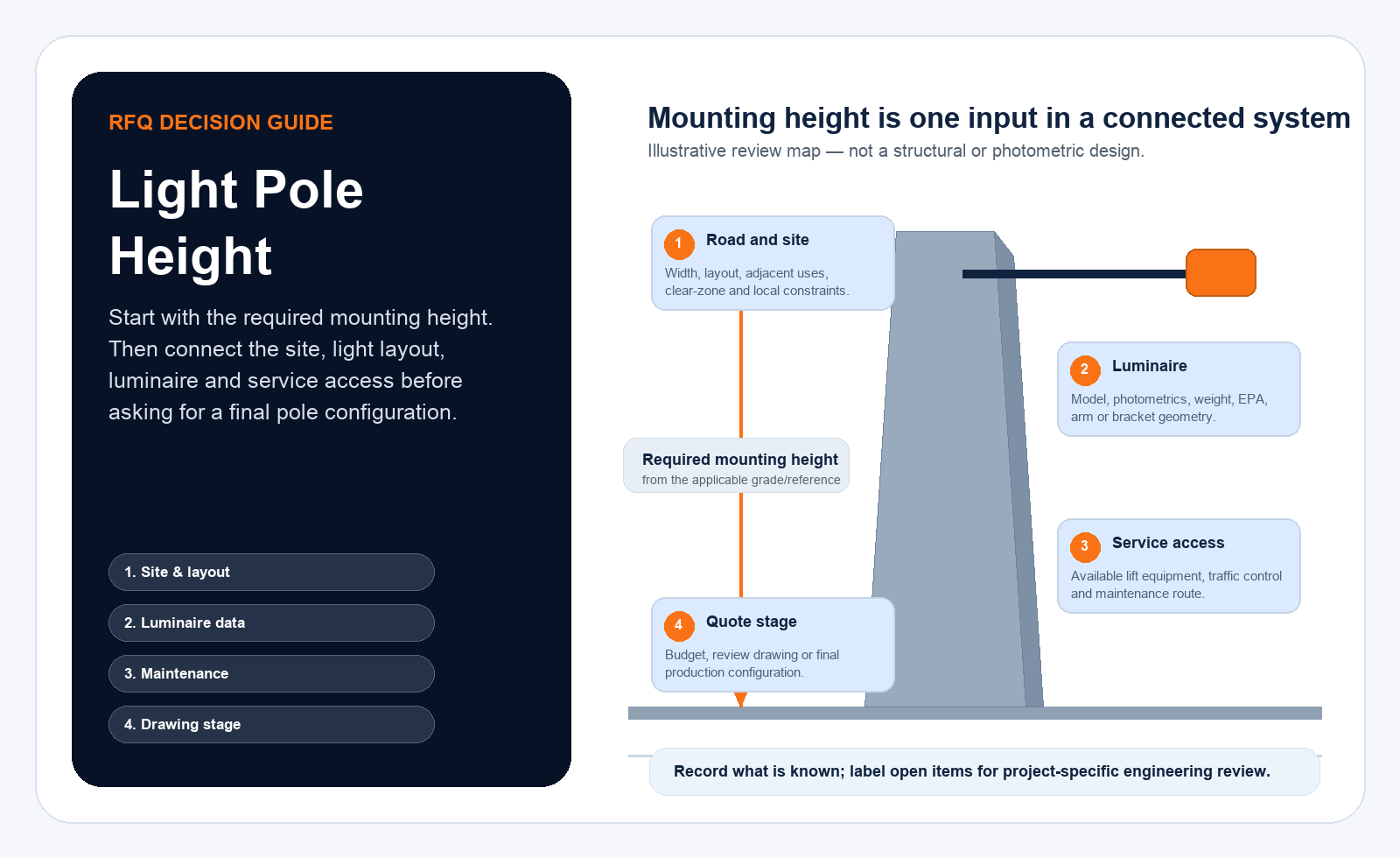
Light pole RFQ guide
How to Choose Light Pole Height: An RFQ Checklist for Roadway and Area Lighting
Choose the mounting-height direction from the lighting application and site—not from a catalogue number alone. This guide turns the question into a clear RFQ checklist for roadway and area-lighting projects.
It is a procurement and briefing guide, not a substitute for the applicable lighting, structural, electrical or local approval process.

The short answer: start with mounting height, then test the whole system
For roadway-lighting discussion, mounting height is commonly defined as the vertical distance from the roadway surface to the center of the apparent light source. That is more specific than the overall physical length of a pole, which can also depend on base detail, embedment or mounting arrangement.
The FHWA Lighting Handbook explains that there is no exact formula for an optimal pole height and luminaire wattage on a given road. The decision connects layout, photometrics, road geometry, lighting levels, uniformity, aesthetics, glare, power-line conflicts and other project conditions. A useful RFQ captures the known inputs instead of pretending that one catalogue height settles the design.
Buyer question
What mounting-height direction fits the application, layout and luminaire data we have?
Drawing question
What grade reference, arm arrangement and equipment geometry must the review drawing show?
Supplier question
Which parts are confirmed, and which remain project-specific engineering assumptions?
Do not mix up these four terms
Using the same word for several dimensions can make a quote look clearer than it is. Define the reference before comparing options.
| Mounting height | The luminaire-height reference used for the lighting discussion; confirm the applicable grade or roadway-surface datum. |
|---|---|
| Overall pole length | The complete physical pole dimension; it may include portions not visible above grade or other project-specific interfaces. |
| Arm or bracket reach | The geometry that moves the luminaire relative to the pole and roadway. It is not interchangeable with mounting height. |
| Pole spacing | Distance between lighting locations in the layout. It is determined through the applicable lighting design, not by a universal rule of thumb. |
Five inputs that shape the height discussion
Height becomes more useful when it is paired with the information that changes performance, access and the physical configuration.
1. Application and layout
State roadway, walkway, car park, industrial area, sports perimeter or another use; add lane count, area dimensions, crossing points and one-sided, opposite, staggered or median arrangement where known.
2. Luminaire and arm data
Share fixture model, photometric file if available, weight, EPA, quantity, tilt, arm or bracket reach and any future device load. These inputs cannot be guessed from a pole photo.
3. Adjacent conditions
Record buildings, trees, utilities, signs, nearby homes, airport constraints, obtrusive-light concerns and any preferred pole face. These can change height, location or shielding discussion.
4. Maintenance access
The FHWA handbook identifies service-vehicle reach and safe luminaire access as relevant considerations. Note available lift equipment, traffic-control limitations and the intended maintenance route.
5. Project rules and drawings
Share the authority specification, design standard, tender notes, local requirements, wind input and the latest site or civil drawing. Do not treat a previous project as a default approval.
A practical way to compare height directions
Use categories as a briefing tool, not as a final selection table. FHWA guidance notes that pedestrian-oriented zones often use lower mounting heights than conventional roadway systems, while complex wide areas can lead to high-mast arrangements with multiple luminaires. The exact configuration still needs the applicable layout and calculations.
| Pedestrian-scale or landscape context | Begin with pedestrian paths, visual scale, trees, nearby façades, light-trespass sensitivity and maintenance access. |
|---|---|
| Conventional roadway or area-lighting context | Begin with the road or area geometry, lighting layout, luminaire photometrics, arm arrangement, traffic-side constraints and fixture service approach. |
| Large or complex area context | Begin with the overall layout, multiple luminaire schedule, optics, maintenance plan, clearance and authority requirements before assuming a high-mast solution. |
| RFQ language | State the target mounting-height range if it is known; otherwise ask for a review against the layout and mark it as an open item. |
RFQ checklist: what to send before asking for a final pole height
A preliminary quote can begin with partial data. Label unknown items clearly so they become review points rather than hidden assumptions.
| Site | Country/city, application, site plan, road or area dimensions, grade condition and nearby restrictions. |
|---|---|
| Lighting brief | Required mounting height or range, lighting layout, fixture schedule, photometric data if available and control-system notes. |
| Pole configuration | Single/double arm or post-top direction, arm reach, shaft preference, material, finish and any accessory or device mounts. |
| Structural inputs | Known wind criteria, fixture EPA and weight, loading schedule, foundation/base-interface information and applicable standard. |
| Operations | Access equipment, maintenance route, traffic-control restrictions, access-door preference and expected service method. |
| Commercial stage | Budget quote, drawing-review quote or final production release; attach tender documents and identify outstanding approvals. |
What not to do
The most expensive ambiguity is a height figure with no reference point, no luminaire data and no layout. Avoid these shortcuts:
Do not use a universal spacing multiplier
A rule copied from another project cannot replace the applicable lighting calculations and site conditions.
Do not send only a nominal pole height
Add whether it is mounting height or overall physical length, and include the grade reference and arm geometry.
Do not overlook maintenance
A pole can be physically possible yet impractical for the available service vehicle, traffic access or maintenance plan.
Do not treat a preliminary quote as final approval
Keep unknown lighting, structural, electrical and local requirements visible until the project review is complete.
Related product and engineering paths
Use the product family to start a conversation, then connect the height brief to the actual site and equipment schedule.
Source references
These public FHWA references support the general framing of mounting height, lighting layout, site constraints and service access. They do not replace the requirements for a specific project, authority or jurisdiction.
FAQ
What is mounting height for a light pole?
For roadway-lighting discussion, mounting height is commonly the vertical distance from the roadway surface to the center of the apparent light source. Confirm the project datum and luminaire geometry before using it as a production dimension.
Can a pole height be selected from a spacing rule alone?
No universal spacing multiplier replaces a lighting layout and project review. Road geometry, luminaire photometrics, mounting arrangement, adjacent uses, maintenance access and local requirements all affect the decision.
What should I send for a preliminary light-pole height RFQ?
Send the site location, application, target mounting height or range, road or area layout, fixture data, arm or bracket arrangement, material and finish direction, known wind input, maintenance constraints and available drawings.
Is physical pole length the same as mounting height?
Not necessarily. Mounting height is a lighting reference, while overall pole length can include project-specific base, embedment or mounting-interface details. Define both on the applicable drawing.
Send a Mounting-Height RFQ
Share the application, site location, target mounting height or range, layout, luminaire schedule, arm arrangement, material, finish, known wind information, maintenance constraints and available drawings.
Leave a Reply