Roadway lighting · buyer and engineering guide
Conical Street Light Poles: RFQ Inputs for Roadway Projects
A conical street light pole quotation becomes comparable when the buyer gives every supplier the same current project inputs: layout, equipment interfaces, stated criteria, base condition, finish, delivery and review route. Height is part of the conversation, but it is not the whole package.

Short answer: quote the issued project package, not a pole silhouette
A conical street light pole is a tapered shaft commonly used for roadway, industrial-access, commercial and municipal lighting applications. Its visible form does not establish the full supplied configuration. The requested pole package depends on the current layout, mounting height, luminaire and arm interface, attached projected area, project criteria, base condition, finish, quantity, destination and review stage.
The useful first step is simple: send the latest information and label anything that remains open. A supplier can then discuss a proposed pole-side configuration against the issued basis. The responsible project parties confirm electrical, civil, structural, installation and authority requirements. That separation protects both the buyer and the quotation from turning unknown interfaces into hidden assumptions.
What the tapered shaft does — and does not — tell a buyer
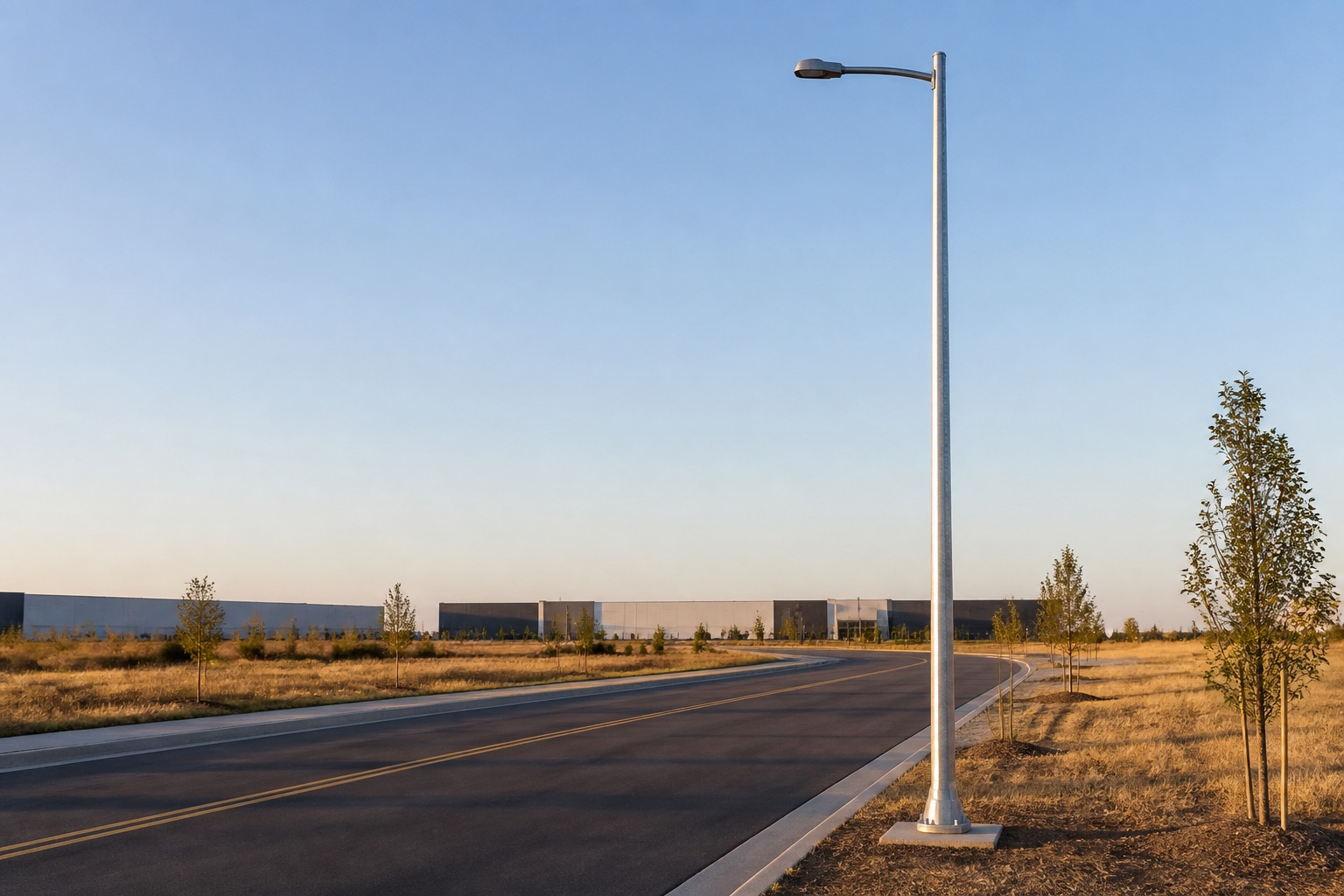
The word “conical” describes the shaft geometry: the diameter reduces from the lower section toward the top. Buyers often prefer the clean proportion, efficient material use and familiar roadway appearance. But a product photograph cannot answer the questions that matter at release: which luminaire is mounted, where its load acts, whether an outreach arm is included, what hand-hole and cable-access arrangement is needed, how the base meets finished grade, or what finish and delivery requirements apply.
Start with the application and the actual site plan. A parking or access-road pole may need a short single arm; a divided roadway may require a different orientation and location record; a city streetscape may have a prescribed finish and approval sample. Treat the shaft as one interface in a project package, not as a standalone object. For an overview of available roadway families, see Roadway Light Poles.
RFQ inputs that make supplier proposals comparable
The table below is deliberately practical. It identifies what changes the proposal and how to send it. It is not a substitute for a project design calculation or approval. Its purpose is to make the buyer’s request consistent, so bidders are not pricing different luminaire assumptions, foundations or delivery boundaries under the same title.
| RFQ input | Why it matters | What to send | Quotation treatment |
|---|---|---|---|
| Roadway layout, quantities and pole locations | A shaft package is tied to actual placement, arm orientation and project phasing | Latest plan with revision date and a pole schedule where available | Identify drawing revision and any unconfirmed locations |
| Luminaire, arm and mounting interface | Fixture mass, shape, mounting and outreach are not established by shaft height alone | Selected cut sheet or a clear pending-equipment note | Quote to issued data or label the equipment interface as open |
| Project wind / projected-area criteria | The project criteria and attached equipment govern the requested structural discussion | Issued project requirements and equipment information, if available | State the design basis supplied by the buyer and open items |
| Base, anchor, cable and finished-grade interface | A pole quote should not silently become a civil or electrical package | Known base detail, bolt/template information, cable-entry notes and grade condition | Separate pole-side supply from foundation, excavation, cable and installation work |
| Material, finish and environment | Corrosion exposure, appearance and maintenance expectations should be visible | Material/finish direction, exposure notes and required approvals | Record specified finish and any pending approval sample |
| Delivery and release route | Packaging, logistics and document timing affect the commercial proposal | Destination, quantity split, requested date and approval path | State freight basis, exclusions and drawing hold point |
The luminaire and arm are not accessories to leave unnamed
A pole is not a universal fixture support. The selected luminaire, mounting method, short outreach arm or tenon interface, and the intended orientation should be attached to the RFQ whenever available. If the luminaire is not final, identify it as pending and describe the decision point. That lets the quotation distinguish a confirmed interface from a provisional one.
The U.S. Department of Energy’s Solid-State Lighting information and its LED Basics page provide general technical context for lighting equipment. They do not select a pole or replace project-specific review. In a live RFQ, issued fixture data and the responsible project criteria take precedence over a general product family description.
Scenario 1: a released industrial access-road package
An industrial campus has a current civil layout, pole locations, a confirmed compact roadway luminaire and a short outreach arm. The buyer can send the plan revision, pole schedule, luminaire data, known base/cable details, finish direction, quantity split, delivery city and requested drawing date. The manufacturer can return a defined proposal for the supplied pole-side package, while showing any civil, cable, installation and authority items that remain outside that supply scope.
This makes commercial comparison easier. One supplier is not quietly pricing a bare shaft while another includes a bracket, hardware or finish that was assumed but never issued. If the layout changes, the next revision can identify the affected locations instead of relying on memory from a preliminary inquiry.
Scenario 2: a municipal corridor with pending fixtures
A municipality has an early corridor plan and a preferred conical appearance, but the luminaires, final arm geometry, finished-grade detail and release date are still under review. The RFQ can still be useful if it says exactly that. Provide the available layout, estimated quantities, environmental and finish expectations, then mark the luminaire and base interfaces as pending. Ask for a budgetary pole-side proposal tied to those stated assumptions and a list of items that must be closed before drawings are released.
That is better than copying another project’s pole drawing into a new tender. A reference drawing can inform visual intent, but it does not automatically transfer equipment loads, site criteria, approval requirements or foundation responsibility. The buyer gets a more honest budget, and the project team has a clear checklist for the next review stage.
Keep pole supply separate from civil, electrical and installation scope
A road-lighting RFQ should name what the supplier is expected to provide: shaft, arm or bracket if included, mounting hardware, hand-hole/access arrangement, base plate or other pole-side interface, finish, packing and delivery terms. It should separately state whether foundation design, excavation, reinforcement, anchor installation, cable, feeder connection, commissioning, aiming, traffic control, permits or inspections are assigned to another party.
This is not a legalistic add-on. It is how a buyer stops a pole quotation from concealing a missing civil or electrical allowance. Where there is known wind or projected-area information, send it with the equipment data. Related guides on wind and EPA RFQ inputs, anchor-bolt and template interfaces and what to send for a light-pole RFQ help organize those records.
Finish, access and maintenance belong in the first request
Galvanized, painted, powder-coated and other finish discussions should be tied to the stated exposure, appearance requirement and approval process. A finish sample, color reference or project specification can be included with the RFQ rather than introduced after a price comparison has been completed. The same principle applies to hand-hole location, cable entry, access-door orientation and maintenance limitations: practical details are easier to price and review when they are known early.
For a supplier, this produces a more stable material and process plan. For the buyer, it reduces the chance that a visually correct pole arrives with an unresolved access direction or finish approval. See how to specify light pole surface finishes for a separate finish-focused checklist.
Use a controlled review sequence before fabrication
The goal of review is not to slow a project; it is to keep the current information connected from inquiry to drawing release. Record the layout revision, confirmed equipment, open interfaces, person or discipline that will confirm each item, and the point at which fabrication may begin. A quotation can be transparent about its project basis without claiming that a supplier has taken over the civil, electrical or authority design role.
| Review point | Question to close | Useful project record |
|---|---|---|
| Budget request | Which interfaces are known and which are deliberately provisional? | A dated RFQ with assumptions visible |
| Quotation review | Are all bidders using the same layout, luminaire, arm, criteria and scope boundary? | A comparison sheet tied to the current revision |
| Drawing review | Does the proposed pole package match the released equipment and base interface? | Controlled drawing comments and approvals |
| Fabrication release | Have finish, hardware, quantities, logistics and change items been closed? | A release record, not an old catalogue screenshot |
What to send now for a conical street light pole RFQ
Send the latest roadway or site layout, quantities and pole locations; the application and desired mounting height; selected or pending luminaire, arm and bracket information; project criteria and relevant attached equipment data; base, anchor, cable and finished-grade notes; material and finish direction; environmental/access notes; delivery destination; requested supply boundary; and drawing-review or release date. Add a document revision and mark the inquiry as budgetary or ready for quotation.
When an input is not final, name it rather than hiding it. Fortune Light Pole can then discuss a conical street light pole package against the issued information, list the supplier-side components, and identify what needs confirmation before drawings or fabrication proceed.
Frequently asked questions
Is a conical street light pole selected by height alone?
No. Height is one input. The issued layout, luminaire and arm arrangement, projected area, site criteria, base interface, finish, quantity and document revision all affect the requested pole package.
Can a buyer use another project’s pole drawing as the RFQ basis?
It can be useful reference material, but it is not a release document for a different roadway project. Identify it as reference and provide the current layout, equipment information, project criteria and responsible review route.
What should be included before a conical pole quotation is compared?
Include the current layout and quantities, pole locations, luminaire and bracket data, project criteria, base or foundation interface, finish, access requirements, delivery destination, requested supply scope and drawing-review stage.
Prepare a comparable roadway-pole RFQ
Send the latest layout, quantities, luminaire and arm interface, known project criteria, base/cable notes, finish direction, delivery requirement, scope boundary and review route. We will discuss a proposed pole-side configuration against those project inputs.
Open RFQ Form
Leave a Reply