Solar lighting · buyer and engineering guide
Solar Light Pole Battery Autonomy: RFQ Inputs for Off-Grid Projects
A solar light pole should be quoted from the actual operating profile, project location, equipment interfaces, service approach and scope boundary—not from a generic number of nights. The project team confirms the design basis; the supplier can discuss a proposed supplied configuration against those inputs.

Short answer: autonomy is a project operating question
Battery autonomy is the ability of a proposed solar-lighting package to support its stated operating profile when solar input is reduced. It is not a universal number that can be selected from pole height, a panel photograph or another project’s schedule. A useful RFQ first says what the owner expects the light to do: required lighting hours, dimming windows, motion response, seasonal operation, monitoring needs and any permitted exceptions.
The location and installed context then matter. Nearby buildings, trees, terrain, dust, soiling, access limits and future site changes can affect the assumptions that sit behind a proposed package. The appropriate project parties confirm these inputs and the required review path. A manufacturer can use the documented information to propose a pole-side system, but it should not represent a general catalogue figure as a guaranteed site result.
What is inside a solar light pole package
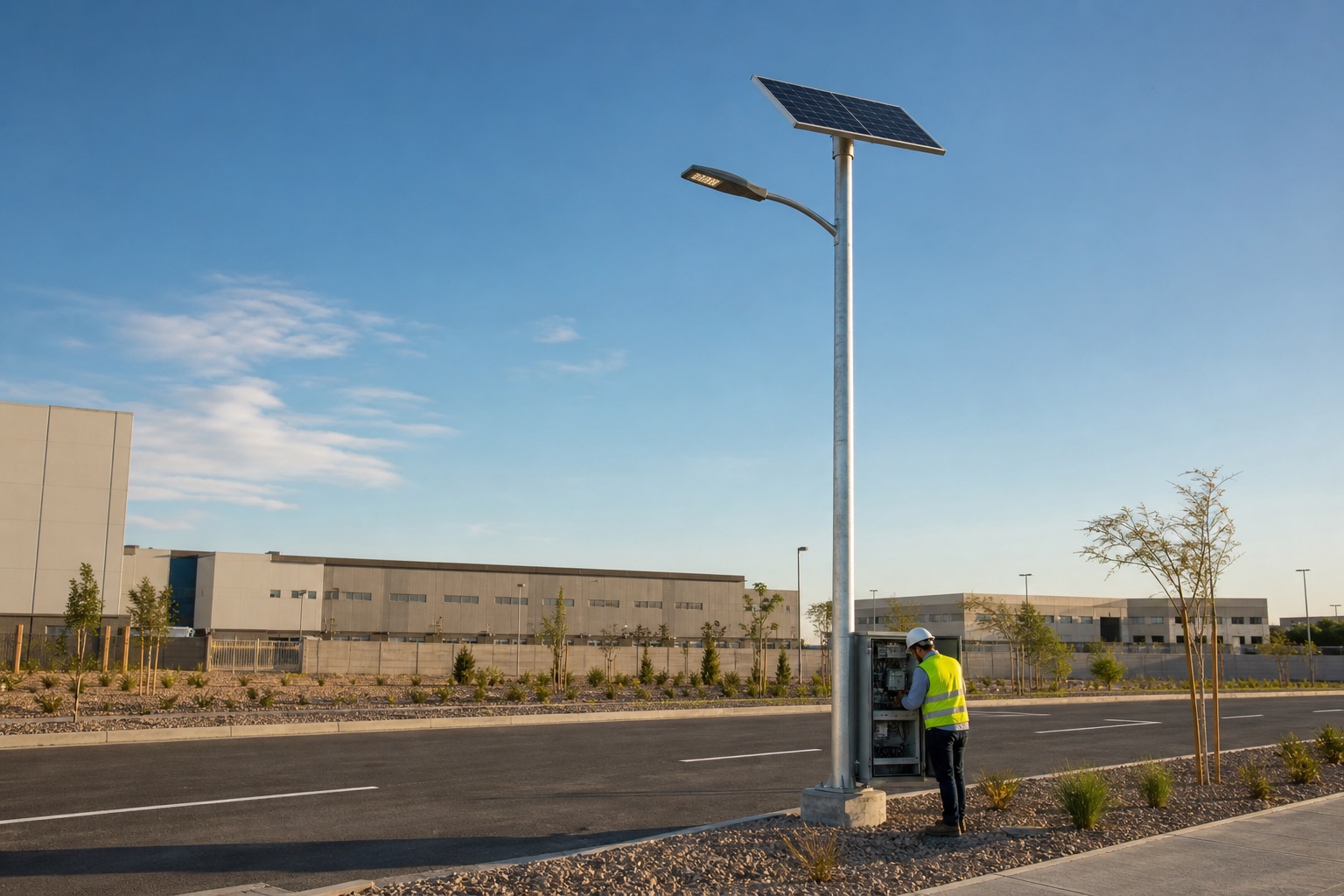
A solar-lighting assembly connects several equipment and project interfaces: the shaft and mounting arrangement, photovoltaic module, selected luminaire, battery and control enclosure, cable or internal wiring arrangement, foundation or base interface, access provisions, finish and project documentation. Some projects use an integrated top arrangement; others use a separate cabinet or project-specific support arrangement. The correct choice is governed by the stated project package, not by a visual preference alone.
The U.S. Department of Energy’s Solar Energy Technologies Office and the National Renewable Energy Laboratory’s solar research provide useful context for solar energy. They are not a substitute for a project-specific lighting, energy, structural, electrical, civil or authority decision. For a product-family overview, see solar light pole options.
Inputs that make a solar-lighting RFQ comparable
The following table separates information that is known from information that needs confirmation. An unknown is not a failure; the problem is letting it become an invisible supplier assumption. If several bidders are using different operating schedules, luminaire data or site contexts, their quotations are not responding to the same requirement.
| RFQ input | Why it changes the proposal | Confirming party | Quotation treatment |
|---|---|---|---|
| Project location and operating season | Solar availability, ambient conditions and seasonal use can alter the energy balance | Buyer / project team | State the stated site basis and any unresolved conditions |
| Required hours, dimming and motion-control logic | Nightly energy use follows actual operation rather than a catalogue headline | Owner / lighting team | Quote against the issued profile or identify an open-item hold point |
| Luminaire data and mounting arrangement | Power, optical configuration and mounting interface affect the proposed package | Lighting / engineering team | Attach selected data or label equipment as pending |
| PV, battery and control-cabinet arrangement | Equipment interfaces, access and service needs must be visible before release | Project team / supplier | Define supplied items and excluded electrical/civil scope |
| Site shading, trees, buildings and future changes | A clear sky assumption may not reflect the installed environment | Buyer / site team | Provide survey information and record assumptions |
| Base, cable, foundation and installation boundary | Prevents a pole quote from silently absorbing civil or electrical work | Buyer / responsible parties | List inclusions, exclusions and required approvals |
Scenario 1: a confirmed industrial access road profile
Scenario 1: an industrial park owner has an issued road layout, pole locations, a defined evening operating schedule and selected luminaires. The buyer can provide the project location, planned use through the year, control behavior, known shading/site information, mounting arrangement and requested review route. The supplier can then propose a defined supplied solar-lighting configuration and list any interface that remains with the electrical, civil, installation or project-engineering team.
The commercial benefit is clarity. One bidder does not assume full-output operation every night while another assumes scheduled dimming; one does not price a separate cabinet while another assumes an integrated arrangement. The buyer can compare the same stated inputs, documentation, finish, hardware and delivery scope before award.
Scenario 2: a remote site with open equipment and access items
Scenario 2: a remote yard or pathway needs lighting, but the operating profile, final luminaire, exact pole locations and maintenance approach are not yet final. The RFQ should identify the intended application and any available site record, then label the remaining items as open. The project team can establish a drawing or review hold point before fabrication rather than asking a supplier to resolve unconfirmed design conditions from a generic autonomy claim.
This matters particularly when future shading, landscaping or new construction may change the site. The supplied pole package can be discussed against a controlled assumption, but the quotation should state that assumption and its scope. A clear change-control process is safer than treating a pre-construction photograph as a permanent energy model.
Operating profile, controls and maintenance are connected
The operating profile is more than the words “dusk to dawn.” A buyer should state whether the light is expected to operate at one level, dim after a stated period, use occupancy response, serve a security route, remain on for an event window or follow another documented control sequence. That profile changes the energy demand considered by the project team. It also affects the discussion of controls, monitoring, cabinet access and fault response.
Maintenance access belongs in the same conversation. Identify who can access the enclosure, what isolation and service process applies, whether a lift or other site equipment is required and what information must be available before a component is changed. A pole supplier can define the supplied equipment and documentation; the responsible parties confirm operational procedures, electrical safety and site access.
Do not hide civil, electrical and authority scope inside a pole quote
A clear solar-light-pole proposal identifies whether it includes the pole, module support, luminaire mounting, battery/control enclosure, pole-side wiring, base arrangement, hardware, finish, packaging and delivery. It separately identifies foundation design, excavation, reinforcement, cable work, distribution, commissioning, installation, aiming, inspections and authority approvals when those belong to other parties. This is not a disclaimer exercise; it is how a buyer compares commercial scope honestly.
The same boundary applies to structural and wind-related information. If a project has issued criteria, provide them. If an equipment interface is pending, say so. Related guides on wind and projected-area RFQ inputs, anchor-bolt interfaces and what to send with a light-pole RFQ help keep those project inputs visible.
Release sequence before fabrication
A controlled release lets the project team compare the latest layout, equipment selection, operating profile, site context, mounting arrangement, base/cable information and scope matrix before a configuration is committed. It does not replace engineering review or authority approval; it gives those parties an accurate package to review.
| Stage | Check before advancing | Result |
|---|---|---|
| Before quotation | Location, quantity, operating profile, equipment status, site context and supply boundary | Comparable proposed configurations rather than untracked assumptions |
| Before drawing review | Current luminaire, PV/battery/control arrangement, mounting, base and access information | A package tied to the current project revision |
| Before fabrication or delivery | Approved drawing route, finish, hardware, logistics and responsibility matrix | Changes are recorded rather than carried by an old RFQ |
What to send for a solar light pole RFQ
Send the current layout and quantities, exact location, application and operating season, required hours and control behavior, selected or pending luminaire information, proposed photovoltaic/battery/control arrangement if known, relevant shading and site context, mounting/base and cable notes, maintenance-access expectations, material/finish direction, delivery destination, requested supply boundary and drawing-review stage. When some data is open, mark it open and name the confirming party. Fortune Light Pole can then discuss a proposed supplied configuration against the same package every bidder receives.
Also identify the document revision and date, whether the request is budgetary or ready for quotation, the requested currency or commercial terms where applicable, and the point at which the buyer needs a drawing package. These simple labels prevent a preliminary concept from being mistaken for a fabrication release.
Frequently asked questions
What autonomy should a solar light pole have?
There is no universal autonomy value. The required operating profile, local solar resource, seasonal conditions, selected luminaire and control logic must be confirmed for the specific project.
Can a supplier choose the battery from pole height alone?
No. Pole height alone does not establish nightly energy demand, photovoltaic yield, battery capacity, cabinet arrangement, maintenance access or the project review basis.
What should be included in a solar light pole RFQ?
Send the location, required operating schedule, selected or pending luminaire data, desired control behavior, site/shading information, environmental conditions, mounting/base information, supply scope and drawing-review stage.
Prepare a clearer solar-lighting RFQ
Send the location, operating profile, selected or pending equipment, site/shading context, known base and cable interfaces, maintenance expectation, supply boundary and review route. We can discuss a proposed solar light pole configuration against those project inputs.
Open RFQ Form
Leave a Reply