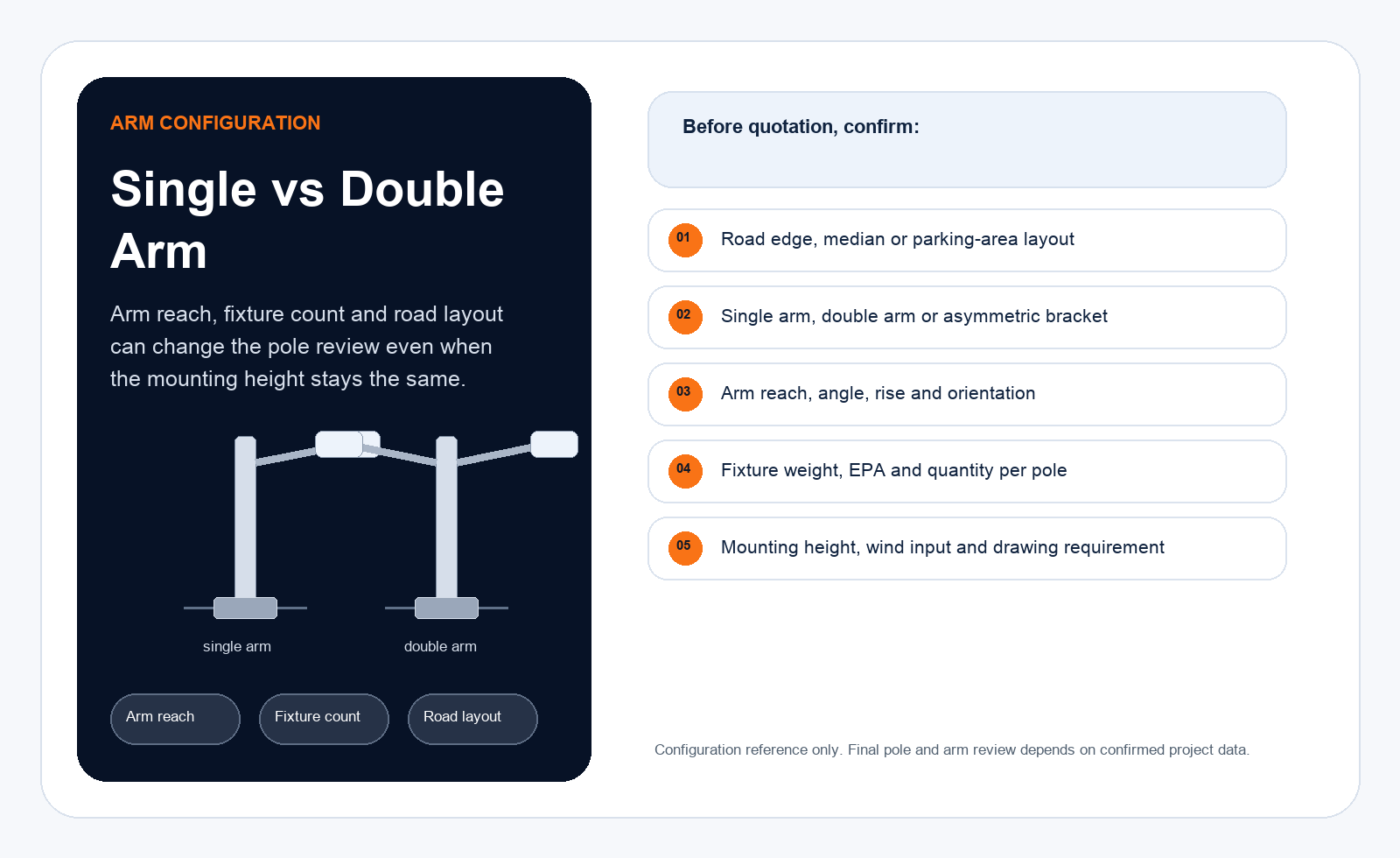
Roadway arm configuration
Single-Arm vs Double-Arm Light Poles
Single-arm and double-arm light poles are not just visual options. The arm layout affects road coverage, fixture count, wind input, bracket detail, transportation length and the information needed for quotation.
Use this guide before requesting roadway, parking-area, median or industrial access road light pole quotations.

Start with the road layout, not the pole style
A single-arm pole usually serves one roadway edge, service lane, parking aisle or area where the fixture projects from one side of the shaft. A double-arm pole usually serves a median, centerline, divided access road or paired lighting direction from one pole location.
The choice should start from the lighting layout: road width, pole spacing, median width, fixture distribution, mounting height and maintenance access. The pole style follows those inputs.
Single-arm poles
Useful for road edges, perimeter roads, parking rows and layouts where light is projected from one side.
Double-arm poles
Useful for medians, central islands and paired directions where one pole supports fixtures on both sides.
Custom brackets
Asymmetric arms, twin fixtures or special brackets should be reviewed with drawings and fixture data.
Why arm reach changes the engineering discussion
Two poles with the same mounting height can require different review when the arm length changes. A longer arm moves the fixture away from the shaft centerline and changes the load path through the bracket and pole top.
The fixture datasheet matters here. Weight and EPA or projected area should be provided together, especially when comparing compact LED luminaires with larger housings or when adding banners, cameras or solar hardware later.
| Arm reach | Horizontal distance from pole centerline to fixture mounting point or bracket end. |
|---|---|
| Arm rise or angle | Upward curve, straight arm, bracket angle and luminaire mounting angle. |
| Fixture quantity | One fixture, twin fixture, back-to-back layout or multiple fixtures on a custom bracket. |
| Fixture weight | Needed for supported load and connection review. |
| EPA / projected area | Needed for wind-area discussion, especially with larger fixtures or accessories. |
| Orientation | Road-facing side, median direction, handhole direction and cable entry position. |
Single-arm light pole RFQ checklist
Single-arm poles look simple, but the quotation still needs the arm geometry and fixture data. A buyer should avoid sending only a height and a product photo.
| Best-fit layouts | Road edge, site entrance, access road, parking aisle, perimeter lighting and industrial roadway edges. |
|---|---|
| Send first | Mounting height, arm reach, fixture model, fixture weight, fixture EPA or projected area and pole spacing if available. |
| Clarify | Straight arm or curved arm, removable or welded arm, decorative requirement, finish and base plate assumption. |
| Common risk | Selecting the pole by height alone and leaving arm reach open until after pricing. |
Double-arm light pole RFQ checklist
Double-arm poles need extra attention because the two sides may not be identical. A median pole may use equal arms, unequal arms, different fixture aiming or different roadway widths on each side.
| Best-fit layouts | Central median, divided roadway, industrial access road, large parking island and paired lighting direction. |
|---|---|
| Send first | Mounting height, left/right arm reach, fixture quantity per side, fixture weight, EPA and road or median sketch. |
| Clarify | Equal arms or unequal arms, arm angle, fixture aiming direction, handhole orientation and maintenance access. |
| Common risk | Assuming a symmetrical double-arm pole when the road layout is actually asymmetric. |
What to send before quotation
A useful arm-configuration RFQ lets the supplier see the pole as part of the road layout, not as an isolated product family.
Layout sketch
A simple top view with roadway edge, median, pole line and fixture direction is enough for early review.
Fixture datasheet
Send dimensions, weight, EPA or projected area, mounting method and quantity per pole.
Arm details
Arm reach, rise, bracket angle, removable or welded connection and whether each side is equal.
Wind data
Send project location and design wind requirement if available. Unknown values should be marked clearly.
Material and finish
State stainless steel, aluminum alloy or open for review, plus powder coating, anodizing or other finish direction.
Drawing need
Say whether you need a quotation only, a concept drawing or a project drawing package.
How Fortune Light Pole handles arm configuration review
Fortune Light Pole reviews single-arm and double-arm poles as project configurations. The starting point is usually mounting height, road layout, fixture model, arm reach and site condition, then the pole material, shaft shape, base plate and finish direction are refined.
For public website content, we avoid fixed promises such as one standard arm working for every road width. Final configuration depends on confirmed fixture, wind, layout and local project requirements.
Configuration first
Arm layout, fixture data and pole height are reviewed together.
Assumptions visible
Unknown fixture data or wind criteria should be shown as assumptions in early quotations.
RFQ-friendly output
When project inputs are clear, quotation and drawing review are faster and cleaner.
Helpful source references
These sources help explain why roadway lighting, luminaire data, structural support and wind inputs should be named clearly before selecting an arm configuration.
Related pages
Continue from arm selection to wind / EPA inputs, roadway product families and RFQ preparation.
FAQ
Is a double-arm pole always stronger than a single-arm pole?
No. Strength depends on the full configuration: pole height, material, shaft design, arm reach, fixture weight, EPA, wind input and base interface.
Can I quote a roadway pole without fixture EPA?
A preliminary quote may be possible, but the fixture EPA or projected area should be confirmed before final pole and arm review.
Are equal double arms required?
No. Some projects use equal arms, while others need different reach or aiming on each side. Send the road layout before assuming symmetry.
Should the arm be removable or welded?
That depends on transportation, installation, maintenance, finish and project preference. The RFQ should state the expected connection if it is important.
Send an Arm Layout RFQ
Share the road layout, pole height, single-arm or double-arm preference, arm reach, fixture datasheet, fixture weight, EPA or projected area, material direction, finish requirement and whether drawings are needed.
Leave a Reply