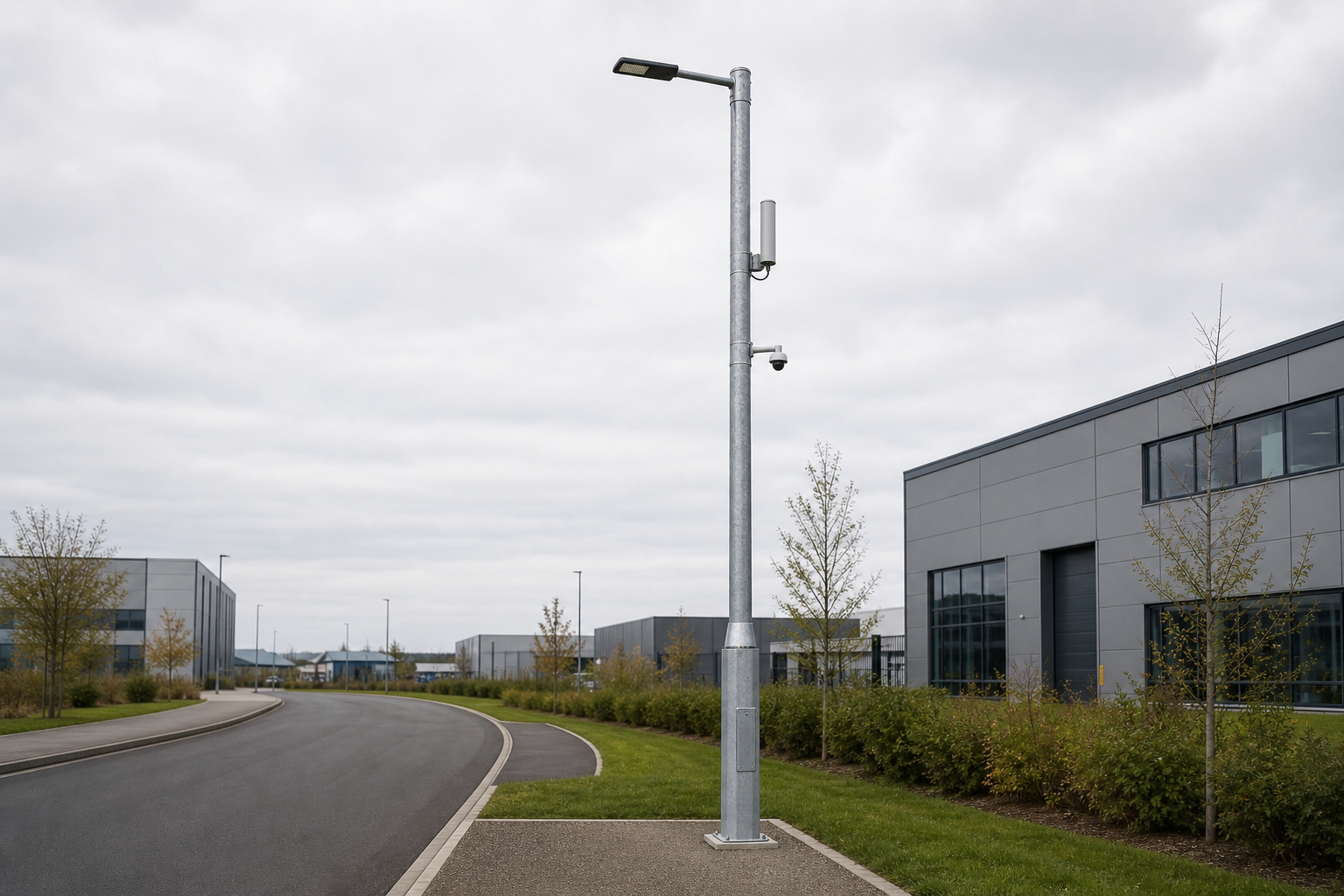
Multifunctional-pole RFQ guide
Multifunctional Light Poles: Equipment and Access Inputs Before RFQ
A multifunctional pole should be quoted from a device schedule and service plan—not from a visual concept alone. List every planned light, camera, antenna, sign, controller and enclosure, then show where it mounts and how it will be reached.
This is a buyer and engineering-input guide. It does not establish structural capacity, electrical design, radio performance, cybersecurity, installation method or authority approval.

The short answer: make the device schedule the starting point
A multifunctional light pole can coordinate lighting with communications equipment, cameras, signs, controls or other project equipment. That coordination starts with the actual device list, not with a generic ‘smart pole’ label.
For an early RFQ, a device may be selected, provisional or still unknown. State which is which. That lets a buyer obtain a useful budget discussion while keeping unconfirmed devices and interfaces out of a final-looking configuration.
Equipment schedule
Every proposed luminaire, camera, antenna, sign, sensor, cabinet, controller and other attachment; include model/datasheet or clearly mark its selection status.
Mounting and cable zones
Preferred mounting faces and heights, equipment interfaces, cable entry and route, separation needs, door direction and any visual or access constraints.
Project review path
Site layout, base/civil status, power/control responsibility, maintenance approach, supply boundaries and the designated review parties.
What belongs in the RFQ package
The list below gives suppliers and project teams a common starting point. It is not a substitute for the documents and responsible reviews required for the specific site.
| Application and site layout | Roadway, business park, pedestrian route, campus, transit, industrial site or another application; provide pole locations, nearby structures, traffic/pedestrian context, drawings and any authority or client requirements. |
|---|---|
| Device schedule | List every planned or possible device. For selected devices, include available datasheets, dimensions, mounting interface, supplied weight or projected-area information where available, cable/control connections and any stated orientation. |
| Pole and mounting concept | Preferred shaft, pole height and finish direction if known; proposed equipment zones, attachment brackets, luminaire arrangement, access-door direction and any visual or architectural constraints. |
| Power, communications and controls | Project-supplied power/control or communications information, cable-entry preference, route, enclosure/interface requirements, ownership boundaries and the parties responsible for the final design. |
| Civil and site conditions | Finished grade, base or foundation status, utility coordination, drainage/site data where available, access restrictions, installation work area and project-supplied environmental criteria. |
| Service and review scope | Maintenance access concept, equipment replacement approach, drawing/submittal needs, responsible structural/electrical/communications/civil reviewers, safety/authority conditions and production-release requirements. |
Separate device selection from device coordination
A camera, antenna or control enclosure can be a valid open item during concept pricing. It should still appear in the RFQ as planned, provisional or excluded. Silent additions are difficult because they may change mounting zones, cable routing, access and the project coordination path.
Where device data is available, send the manufacturer documentation. Where it is not available, describe the expected function, location and responsible party rather than inventing equipment dimensions or loading data.
Plan access before finalizing mounting zones
The service approach belongs beside the device schedule. Identify the access door, expected maintenance direction, working-area constraints, traffic or pedestrian restrictions and the project party responsible for the final maintenance plan.
This avoids treating a clear visual elevation as proof that each enclosure, cable connection and mounted item can be serviced on the actual site. Keep unknown service constraints visible for the designated project review.
At the shaft
Access-door location, cable entry, enclosure zones, mounting faces and equipment that needs service at lower level.
Above grade
Luminaire, camera, antenna and sign positions; proposed maintenance access, obstructions, adjacent buildings and operating restrictions.
At the site
Work area, roadway/pedestrian controls, utility/civil interfaces, asset ownership and the parties that approve access arrangements.
A practical RFQ sequence
A clear sequence keeps early commercial discussion separate from final project release.
| 1. Concept or budget | Send the layout, preliminary device schedule, preferred pole appearance, known interfaces and an unresolved-items list. |
|---|---|
| 2. Equipment coordination | Align actual devices, mounting zones, brackets, cable and power/control interfaces, access-door direction and the base/civil status. |
| 3. Project review | Confirm responsible structural, electrical, communications, civil, installation, maintenance, safety and authority reviews, with required drawings and documentation. |
| 4. Production release | Release only the approved pole configuration, equipment schedule, interfaces, finish, supply scope and project documents after designated confirmation. |
Common gaps that create rework
A short list of open items is more useful than a polished concept that hides unselected equipment or unclear service responsibilities.
Only a rendered concept is provided
Add a device schedule, mounting zones, cable/power notes, access direction and the latest site layout.
Devices are added after pricing
Mark anticipated cameras, antennas, signs or cabinets at concept stage—even if final models are still open.
Cable route is not assigned
Identify entry preference, project power/control and communications boundaries, route assumptions and responsible coordination parties.
Service access is omitted
State working-area, traffic/pedestrian, equipment-replacement and maintenance constraints before final mounting zones are released.
Related guides for the project package
Use these linked guides to connect equipment coordination with pole, bracket, foundation and RFQ inputs.
Source references
These public FHWA and U.S. Department of Energy references provide general lighting-infrastructure context. They do not replace project-specific structural, electrical, communications, civil, access, safety or authority requirements.
FAQ
What is a multifunctional light pole?
A multifunctional light pole is a project-specific pole concept that may coordinate lighting with items such as communications equipment, cameras, signage or control hardware. The actual equipment, interfaces, access and review requirements need to be stated for the project rather than assumed from the category name.
What should be included in a multifunctional pole RFQ?
Include the site layout, a device schedule, mounting-zone preference, equipment datasheets or selection status, cable and power/control interfaces, access-door and maintenance approach, base or civil status, finish environment, supply boundaries and the responsible project-review parties.
Can devices be added after a light pole is priced?
They can be discussed later, but late additions can change interfaces, mounting locations, cable routing, access and the project review path. Identify planned or open devices early and label unknown equipment clearly.
Who confirms the final multifunctional-pole arrangement?
The responsible project parties confirm the final arrangement through the applicable structural, electrical, communications, civil, installation, maintenance, safety and authority review. A supplier quotation or buyer guide does not replace that process.
Send a Multifunctional-Pole RFQ
Send the site layout, device schedule, data sheets or selection status, mounting zones, cable/power/control notes, access constraints, base/civil information and required review stage. Mark open items clearly.
Leave a Reply