Roadway lighting · RFQ data guide
Light Pole EPA: Fixture and Mast-Arm Data to Send With an RFQ
The useful EPA conversation starts with the actual attachments. Send the current luminaire, mast arm, mounting position and every accessory that may remain on the shaft, then separate confirmed project data from items still awaiting design or owner selection.

Short answer: EPA is an attachment record, not a stand-alone purchase field
Effective projected area is often discussed early because fixtures, arms and secondary equipment affect the pole configuration that a supplier is asked to review. Yet an isolated EPA number does not tell a manufacturer what is actually on the shaft, where it is installed, whether the equipment sheet is final, or which project wind and approval path applies. For an RFQ, the stronger starting point is a traceable attachment record.
That record should connect the current pole schedule and layout to each luminaire, mast arm, bracket, banner, camera, sign, communications device or planned provision. It also needs a boundary: the supplier can discuss a proposed pole-side package against supplied inputs; the responsible project parties confirm the structural, civil, electrical, installation and authority requirements. This is not a distinction for legal fine print. It is how a comparison remains usable when the project changes.
Why the fixture, arm and position must travel together
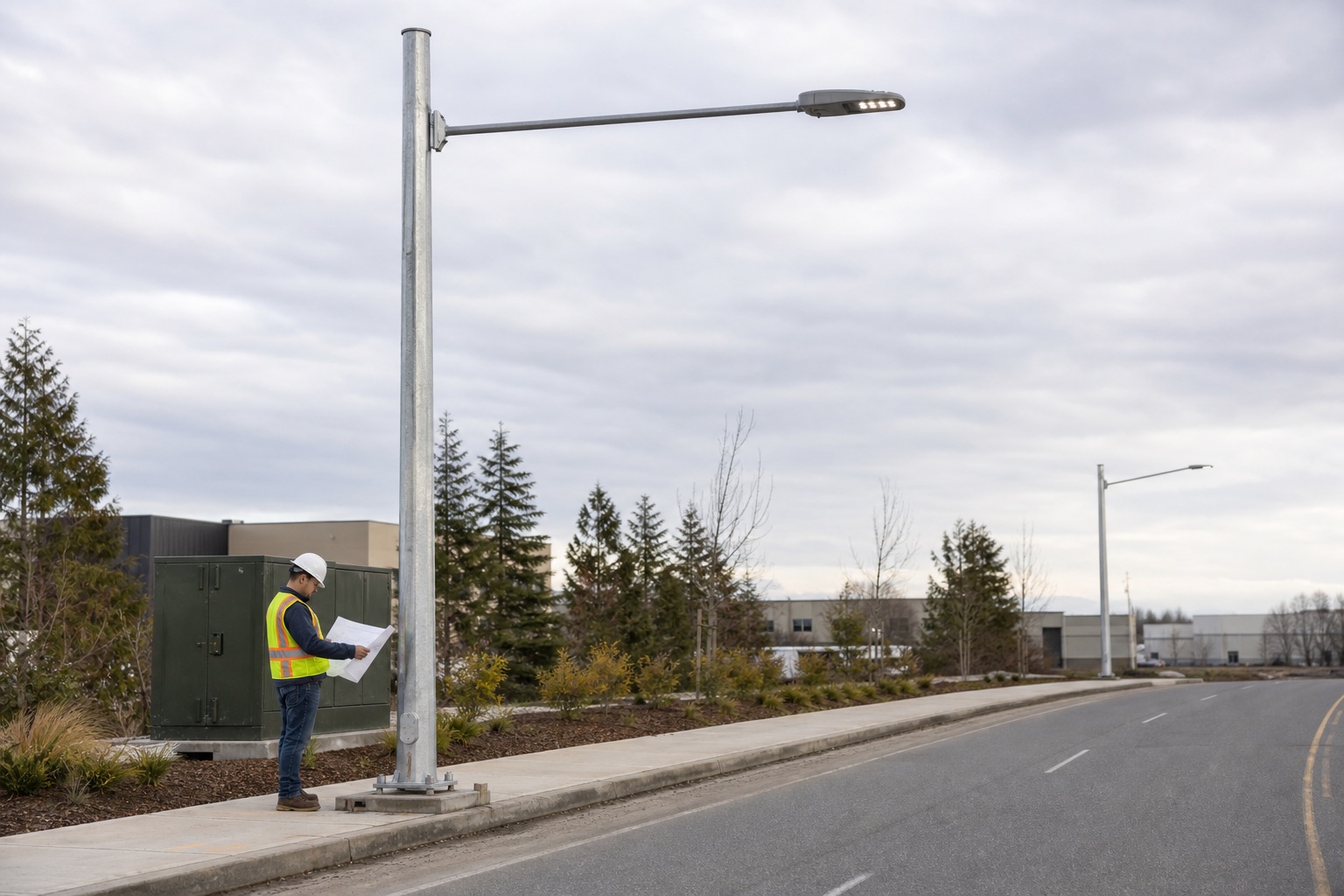
A roadway luminaire is not simply a weight at the top of a pole. Its housing, optical orientation, mounting method and relationship to a mast arm or bracket form a physical assembly. Moving the same fixture to a different elevation, changing an arm direction, replacing a bracket, or adding a second luminaire can change the configuration that appears on a supplier drawing. A quote based on an old cut sheet can therefore become difficult to compare with one based on the current design intent.
Provide the fixture manufacturer and model when available, but also include the number of luminaires per pole, any arm or tenon connection, intended mounting elevation, orientation, and whether the item is issued or still preferred. If a substitute is under review, put it on a separate line rather than allowing the word “equivalent” to hide an unresolved interface. The related tenon and slip-fitter interface guide can help a buyer describe that connection without treating a generic detail as a final project drawing.
Build an attachment register before asking for a pole proposal
The most practical RFQ attachment register is short enough to be kept current. It names each item, its pole location or group, status, mounting interface, expected position, supplying party and whether it is inside or outside the pole supplier’s scope. It should include hardware that is easy to overlook: decorative banners, holiday provisions, surveillance cameras, wireless equipment, signs, emergency speakers, junction equipment and future stubs.
This does not mean every future idea must be engineered into a first budget quote. It means the buyer states which items are confirmed, which are potential, and which are explicitly excluded. The manufacturer can then identify what it is pricing and what further data would be needed before a later review. That approach is especially important for multifunctional poles, where different owner teams may be responsible for lighting, security and communications equipment.
RFQ inputs that make EPA discussions comparable
Use the current plan revision and schedule as the spine of the inquiry. Then attach the equipment sheets and add a simple status column. The goal is not to ask a sales team to perform the engineer of record’s work. It is to make sure that every proposed pole is being discussed against the same visible input set.
| RFQ input | Why it matters | Confirming party | Quotation treatment |
|---|---|---|---|
| Luminaire cut sheet and quantity | Housing, optic, mounting and count affect the pole-side interface being discussed | Lighting designer or equipment owner | Attach the current revision; mark pending substitutions |
| Mast arm or bracket geometry | Length, rise, direction and connection are not interchangeable with a catalogue photo | Responsible structural and lighting parties | State issued dimensions or identify the interface as open |
| Mounting elevation and orientation | The attachment position changes the proposed configuration and drawing review | Project layout and lighting teams | Reference the pole schedule and current plan |
| Banners, cameras, signs and future devices | Secondary accessories may change the attachment set and commercial scope | Owner, security, communications or signage team | List present, future and excluded items separately |
| Project location and wind basis | The applicable project record controls the engineering review, not a generic online value | Engineer of record or responsible authority path | Provide the specified basis and unresolved assumptions |
| Foundation, grade and cable interface | Pole supply must not silently include unassigned civil or electrical work | Civil and electrical project parties | Separate supplied hardware from other-party scope |
Project wind and code references need their own line
A public standard page can explain where a project team starts its structural or traffic-control reference work, but it cannot replace the project record. ASCE describes ASCE 7 as a minimum-design-load standard, while the FHWA MUTCD is a traffic-control resource. Neither page selects a finished pole, arm, foundation or authority approval for a specific site.
The RFQ should instead point to the project’s stated wind basis, location, governing document revision, responsible review party and any unresolved assumptions. Avoid copying a number from a prior job, an online discussion or a catalogue chart into a new request. If the project is still at budget stage, say so. A clear pending item is more useful than a confident-looking value with no approved basis. For a broader buyer checklist, see wind load and EPA inputs for light poles.
Scenario 1: a released arterial lighting package
A municipal arterial project has an issued layout, pole schedule and luminaire cut sheet. Each pole carries one specified LED roadway luminaire on a named mast arm. The buyer sends the current drawing revision, fixture sheet, arm geometry, intended mounting elevation, pole locations, known cable-entry detail, finish direction and the project’s stated review route. There are no banners or cameras in this phase.
That package allows a manufacturer to discuss a pole-side proposal against a released interface. The quote can still state what belongs to civil work, electrical connection, installation and authority review. The buyer can compare proposals because the same fixture and arm information traveled to every bidder. If the luminaire changes after quotation, the team can identify the affected poles and issue a controlled revision rather than asking suppliers to infer the impact from a new product photograph.
Scenario 2: a campus boulevard with future equipment
A campus wants roadway lighting now but expects cameras and event banners in a later phase. The lighting fixture is selected, while the security and signage teams have not issued final device sheets. The buyer should provide the present lighting package, pole locations, proposed future-device zones, an expected program date and a note that the camera and banner interfaces are not released. It should also identify whether any future provision is requested in the budget scope or only being recorded as an open item.
This scenario is not less professional because it contains uncertainty. It is more reliable because the uncertainty is named. The pole supplier can quote the current lighting package, offer a separately identified option where appropriate, and state which future device data would be needed for review. The owner avoids receiving a price that appears to include future capability but has no defined equipment, location or responsibility behind it.
Separate pole supply from civil, electrical and installation scopes
An attachment register does not settle excavation, foundation, reinforcement, trenching, cable, grounding, connection, testing, traffic control, permits or final inspection. Those are project interfaces that should be visibly assigned. In the same way, a base plate or anchor-bolt detail is not interchangeable with a pole quote unless the project record says what is being supplied and who confirms the remaining work.
State whether the requested scope includes the shaft, mast arm, luminaire mounting hardware, access opening, finish, packing, delivery and any named pole-side accessories. State separately what the responsible civil, electrical, structural, installation and authority parties will provide or approve. The base plate and anchor bolt guide and roadway foundation RFQ guide are useful prompts for that division of work; they are not replacements for project design.
Use a drawing-review sequence instead of resolving changes by email memory
Equipment changes are normal. What causes trouble is losing the connection between the change, the affected pole locations and the latest drawing. Keep the fixture sheet, attachment register, plan revision, pole schedule and quotation assumptions together. If one arm changes direction or a camera is added, record the issue, the affected pole mark, the confirming party and the requested response before the document is released.
A controlled sequence makes a quotation easier to defend internally and a manufacturing review easier to perform. It also avoids the false choice between “quote now” and “wait for every project decision.” A buyer can request an early budget, provided the record distinguishes the confirmed package from the open items that need a later review.
| Review point | Question to resolve | Useful controlled record |
|---|---|---|
| Budget request | Which fixtures and accessories are confirmed, and which are placeholders? | Equipment matrix with revision dates and assumptions |
| Comparable quotation | Are bidders using the same arm, elevation, accessory and scope assumptions? | RFQ comparison sheet linked to one plan revision |
| Shop-drawing review | Do shaft, arm, attachment points and access interfaces match released inputs? | Marked drawing set with closed comments |
| Fabrication release | Have equipment changes, interfaces, quantities and delivery details been closed? | Written release and change-control record |
What to send now with an EPA-focused light-pole RFQ
Send the latest layout and pole schedule; current luminaire data and quantities; mast arm, bracket or tenon details; intended mounting elevations and orientations; an attachment register for banners, cameras, signs, communications equipment and future provisions; project location and stated wind/review basis; known grade, base, cable and civil interfaces; finish and delivery requirements; and a line-by-line supply boundary. Mark the inquiry as budgetary, quotation-ready or pending design review.
Fortune Light Pole can use that record to discuss a proposed roadway-lighting pole configuration and documentation route. To move the project forward, send the current plan, equipment sheets and open-item list through the RFQ form. A clear record produces a clearer commercial response than an EPA value copied without its fixtures, arms and project context.
FAQ
Is an EPA value alone enough to release a light pole?
No. An EPA figure needs its reference condition, the actual fixture and arm configuration, mounting position, accessories, project wind basis, shaft proposal and the responsible-party review path. A catalogue number or a previous project is not a release record.
What fixture information should accompany an EPA request?
Send the current luminaire cut sheet, quantity per pole, mounting arrangement, intended elevation, orientation, bracket or slip-fitter interface, and any pending equipment selections. Identify whether the sheet is issued, preferred, or only a budget placeholder.
Do banners, cameras and signs belong in the same RFQ record?
Yes. List every projected accessory that may be attached to the pole, including banners, cameras, communications equipment, signs, brackets and future provisions. Each item should show its location, supplier, current status and who will confirm the final interface.
Can a pole supplier approve the whole project wind or foundation design?
The responsible project parties confirm structural, civil, electrical, installation and authority requirements. A pole supplier can discuss a proposed supplied configuration against the project information and identify the missing inputs needed for its review.
Leave a Reply