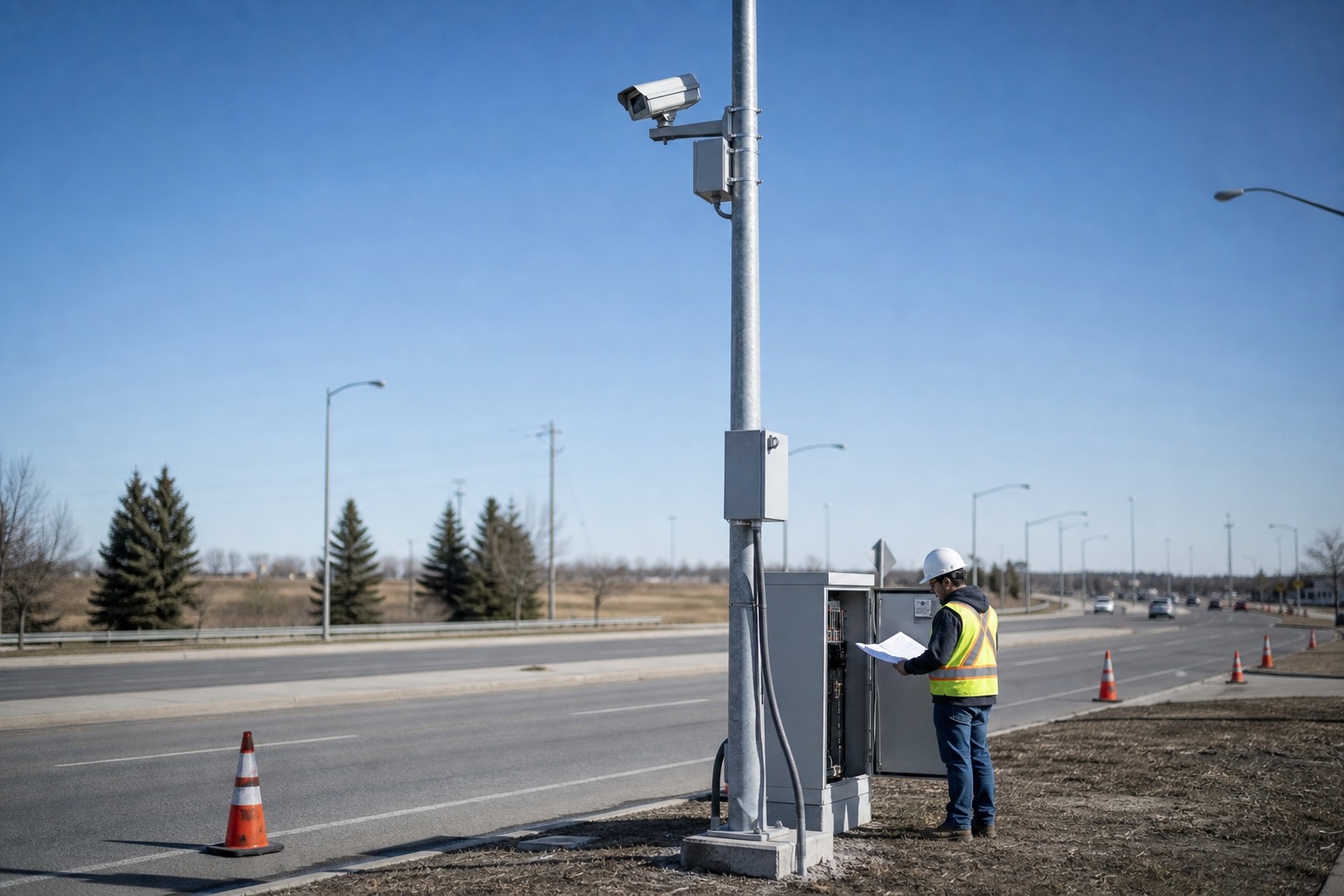
B2B camera-pole and ITS field-equipment procurement guide
Camera Pole Design RFQ: Field of View, Network and Maintenance Access
Short answer: a camera-pole RFQ should start with the issued field record and the agreed system handoffs, not only a nominal pole height or a camera catalogue image. Record the intended camera location and field-of-view basis, the confirmed pole-side mounting scope, known cabinet, power and network interfaces, service-access expectations, document revision and release route. Keep unresolved decisions visible and assigned to the responsible project parties.

Camera poles sit at the meeting point of roadway hardware, surveillance or operations equipment, communications, power, civil work and maintenance. A buyer may have a pole mark, a preliminary location, an existing cabinet, a camera model under review and an ambitious delivery date. Those records are useful, but they do not by themselves define a fabrication-ready assembly. The camera's operational purpose, the actual field-of-view acceptance, the network path, cabinet ownership, electrical handoff and service route may all be controlled by different teams.
This is a commercial RFQ and document-control guide. It does not determine surveillance coverage, structural capacity, electrical design, cybersecurity, communications architecture, civil design, installation method or authority approval. The owner, designer, operator, integrator, contractor and applicable authority retain their responsibilities. Fortune Light Pole can quote the agreed pole-side supply scope and identify commercial clarification needs against the documents provided.
Define the camera-pole decision before asking for a quotation
State what the project is trying to accomplish: a new traffic-management camera location, a replacement support, a corridor expansion, a site-monitoring point, a temporary operational arrangement or a multi-device pole. Then state whether the enquiry is for a budget indication, a comparable commercial proposal or a release-ready supply package. A pole quote is not the same thing as an integrated camera-system procurement.
FHWA describes CCTV cameras, communications networks and central equipment as connected elements of roadway active-traffic-management systems. Its design-considerations guidance is useful context for why a camera location is more than a shaft selection. It is not a project-specific pole specification. The responsible project team still decides what equipment is needed, how it is operated and which documents govern the particular location.
Separate the field-of-view record from the pole-side supply scope
The camera operator or designer may have a coverage objective, an existing view, a drawing, a site photograph or a corridor operations plan. Put that evidence into the RFQ as a controlled reference, but do not convert it into an unassigned factory assumption. Identify whether the buyer has issued the camera position, mounting arrangement, orientation range, field-of-view acceptance record and any equipment constraints. If one of those items is pending, name it as pending.
A pole supplier can respond to the supplied mounting arrangement, agreed bracket or arm, shaft, access provisions and other stated pole-side components. It should not certify that a proposed height, camera position or orientation produces an approved view. That decision belongs with the project parties who define operational coverage and acceptance. This distinction is especially important in a retrofit, where an old pole or camera image may not show the current lane geometry, obstructions, network needs or project review process.
| Field and system input | Why it matters to the RFQ | Responsible confirming party | Quotation treatment |
|---|---|---|---|
| Location, pole mark and quantity | Connects each supply item to the current project record and delivery sequence. | Owner, designer or contractor | Quote by issued mark; list incomplete location data. |
| Camera purpose and field-of-view record | Separates an operational objective from a supplier's material assumption. | Owner, operator or surveillance designer | Reference received information; identify unissued acceptance data. |
| Camera, bracket and mounting interface | Defines the known equipment relationship at the pole. | Equipment owner, integrator or designer | State included pole-side mounting items and open interfaces. |
| Cabinet, power and network handoff | Shows where supply scope meets electrical and communications work. | Electrical contractor, integrator or communications team | List known handoffs and exclusions without inferring a system design. |
| Service route and access expectation | Prevents a material quote from being mistaken for a maintenance plan. | Owner, maintainer or installer | Quote stated access features; flag unassigned field work. |
Use a network and cabinet handoff register
Field cameras may be part of a larger network and operations environment. FHWA's video-streaming guidance notes that field camera streams depend on an end-to-end equipment and network arrangement. The commercial lesson is not that every camera pole needs the same cabinet or connection. It is that an RFQ should state what is known about the handoff and who owns the unresolved decisions.
List the identified cabinet or enclosure reference, cable or conduit boundary, power-supply boundary, grounding or bonding documents where issued, network demarcation, fibre or wireless responsibility, equipment owner, test or commissioning responsibility and record of required submittals. The pole supplier can state what it supplies. The project must assign everything that reaches, enters, mounts on, connects to or is maintained through the supplied pole-side assembly.
Do not turn a maintenance need into an unpriced inclusion
A camera system needs a service concept, but the system's maintenance plan is not automatically a pole manufacturer's scope. FHWA's ITS-device maintenance appendix includes examples of camera-level inspection and maintenance activities. It shows why access, records and assignment matter; it does not prescribe a universal maintenance interval, cabinet layout or access approach for a new project.
In the RFQ, ask what access features or pole-side provisions are specified, where the maintainer is expected to work, which party handles traffic control and isolation, who opens cabinets, and what record must be delivered at handover. A supplier may quote an agreed access opening, mounting feature or hardware. It should not silently accept field servicing, lifts, electrical isolation, network configuration, camera commissioning or work-zone control unless those services are expressly included.
Scenario one: an issued corridor camera package
Example: a transportation agency issues a camera-pole schedule with location marks, quantities, current drawings, a released camera and bracket interface, cabinet reference, network demarcation, issued base detail, finish direction, submittal requirements and phased delivery plan. The operations team owns field-of-view acceptance, the integrator owns camera configuration and network commissioning, and civil and electrical contractors have defined scopes.
That package allows suppliers to compare the same pole-side scope. A proposal can identify the shaft, agreed mounting elements, access provisions, finish, documentation, packing and delivery assumptions. The buyer can see which response follows the issued record and which needs clarification, without asking a factory to decide how the camera will operate or how a field crew will install it.
Scenario two: a site is identified but interfaces are still open
Example: an owner wants a preliminary lead-time and supply estimate for a future camera point. A sketch identifies the general location and a provisional camera type, but the final field-of-view review, network path, cabinet selection and base detail are not complete. The RFQ requests a preliminary pole-side proposal and includes an open-items register with responsible owners.
The factory can provide a transparent commercial response that records the assumed configuration and the inputs needed for revision. The buyer can then use the response for planning while the operational, communications, electrical, civil and approval teams close their decisions. The correct production trigger is the controlled release record, not the fact that a preliminary image or early location exists.
Compare proposals by the interface assumptions they declare
Compare the received drawing revision, location marks and quantities first. Then compare the stated shaft and mounting configuration, camera or bracket interface, cabinet or access features, finish, documentation, delivery sequence and exclusions. Check whether each proposal identifies the same network and power handoff, or whether one supplier has assumed a cabinet, cable route, field installation or commissioning activity that another supplier excludes.
The site's communication-pole RFQ guide, hand-hole and access-door guide, multifunctional pole range and RFQ form can help organise a commercial request. They do not replace the issued project package or the responsible parties' approval process.
Control the release sequence
| Stage | Buyer's controlled record | Supplier response | Release condition |
|---|---|---|---|
| RFQ issue | Location, quantity, known field record and requested pole-side scope. | Commercial proposal, assumptions and clarification register. | Open field, network and access items remain visible. |
| Interface alignment | Current camera, mounting, cabinet and handoff information with named owners. | Proposed configuration against the issued inputs. | Supply boundary is agreed. |
| Submittal review | Current drawing revision and project review route. | Agreed pole-side drawings and documentation. | Responsible reviewers complete their process. |
| Fabrication release | Approved release record and change-control contact. | Production timing for agreed scope. | Pending interfaces are not treated as approval. |
| Delivery and handover | Delivery point, receiver and assigned site interfaces. | Packing and delivery information. | Installation, commissioning and maintenance scopes remain assigned. |
What to send with a camera-pole RFQ
Send the current location plan and pole schedule, quantity, camera and mounting information where issued, field-of-view record or decision owner, known cabinet and access requirements, power and network handoff details, finish direction, issued civil-interface documents, submittal route, delivery need and a list of unresolved items. Identify whether the request is budgetary, commercial or release-ready. That lets every bidder respond to the same question.
Fortune Light Pole can prepare a proposal for the agreed pole-side scope and identify commercial clarification points. Operational coverage, communications, power, cybersecurity, civil, structural, installation, traffic-control, commissioning and authority decisions remain with the applicable responsible project parties.
Frequently asked questions
What should a camera-pole design RFQ include?
Include pole marks and quantities, current location and field-of-view records, issued camera and mounting information, known power and network handoffs, cabinet or access needs, document revision, delivery requirements and a named owner for unresolved interfaces.
Can a supplier determine the final camera field of view from a pole quote request?
No. The owner, operator, designer or other responsible project parties define the camera coverage and acceptance basis. A supplier can quote the agreed pole-side scope and identify the information required for that scope, but does not replace surveillance, operational or authority decisions.
Who confirms cabinet, power, network and maintenance responsibilities?
Those boundaries remain with the owner, system integrator, communications team, electrical contractor, civil contractor, installer, authority or other responsible parties named in the project package. The RFQ should identify each handoff instead of silently assigning it to a pole supplier.
Next step: make the camera-pole RFQ comparable
Share the current field and interface record
Send the location plan, pole marks, camera and mounting data, known cabinet and network handoffs, required access features, document revision, delivery need and review stage. We will identify commercial clarification items and propose the agreed pole-side supply scope.
Primary sources
- FHWA Active Traffic Management design considerations — field-camera, communications and central-equipment context, not a project-specific specification.
- FHWA traffic-management-center video-streaming guidance — end-to-end field-camera and network context.
- FHWA ITS-device maintenance procedures — maintenance-record context, not a universal project maintenance plan.
Leave a Reply