Verified municipal project update · August 2026 analysis
Seattle Magnolia Playfield Lighting Reaches 100% Design: RFQ Checks Before Bid
Seattle Parks reports that Magnolia Playfield’s lighting replacement is in 100% design review and is anticipated to bid in late summer 2026. The project is useful procurement context, not a universal pole, foundation, electrical or approval specification.

What the Seattle project update says
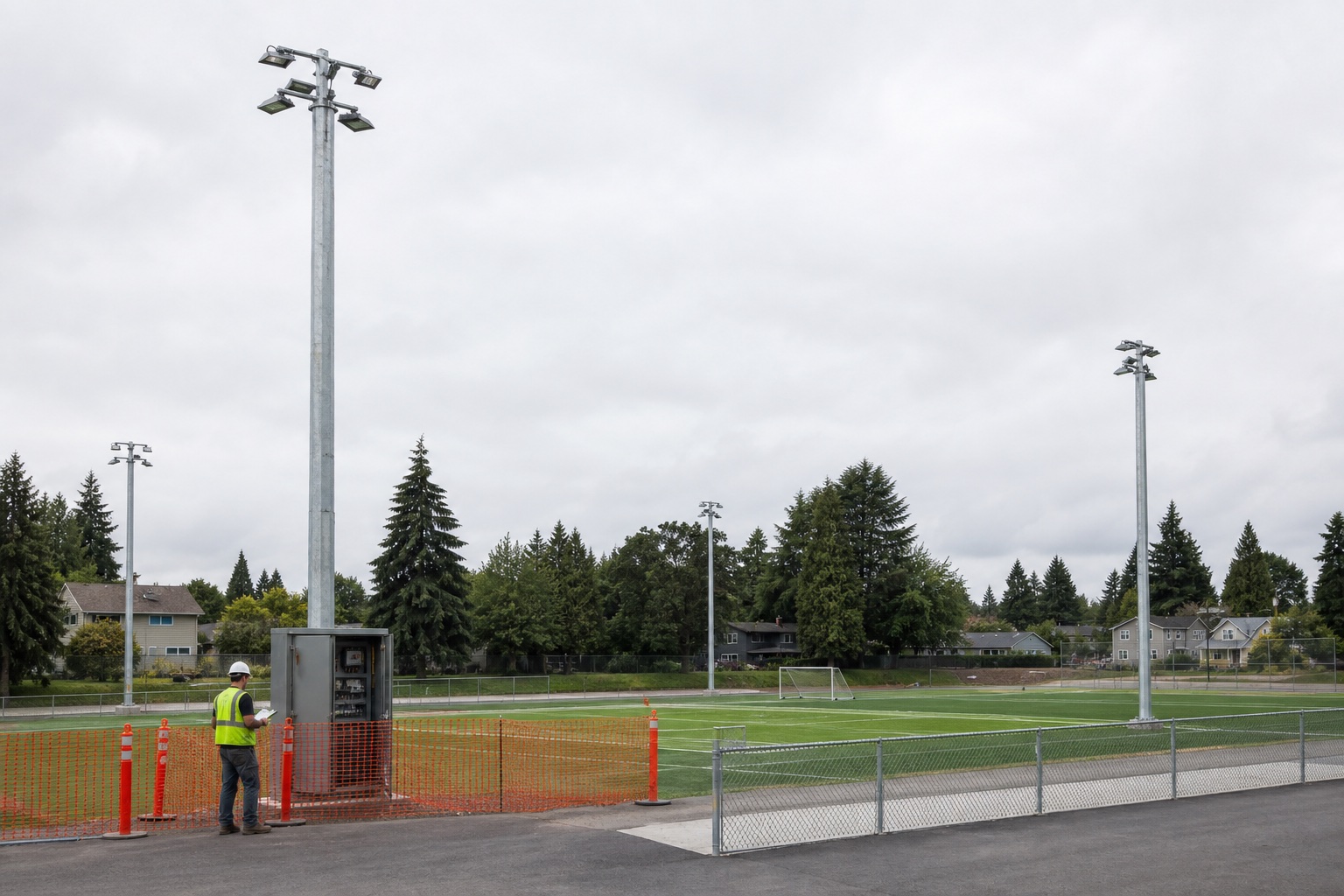
Seattle Parks and Recreation’s Magnolia Playfield Lighting page, updated July 10, 2026, says the replacement project is in 100% design review, has been submitted for final review before anticipated late-summer 2026 bidding, and is scheduled for construction beginning in fall 2026. The page describes demolition of existing poles and fixtures, installation of new poles, fixtures and electrical control equipment, and project goals that include reduced light spill, more efficient LED lighting and safe, uniform lighting levels.
That is meaningful market context for a sports-lighting supplier or buyer: the published project description treats poles, fixtures and controls as an interconnected field package. It does not publish a transferable equipment schedule, approved shaft design, fixture loading, foundation value or procurement award. Those items must come from the current project documents and responsible review path.
Why 100% design review is a procurement signal, not a fabrication release
A design milestone generally means the owner is moving toward a controlled bid package. It does not mean a manufacturer should infer dimensions or release a pole configuration from a public project page. Bidders need the issued drawings, specifications, addenda, quantity/location schedule, equipment status and bid instructions. The distinction protects both the buyer and the supplier from pricing different assumptions behind the same project name.
For a quote request, name the drawing revision and date, state whether the request is budgetary or tied to a current bid, and record selected versus pending luminaires, mounting components, controls and site interfaces. If a field verification or authority review remains open, keep it open in the RFQ and assign a confirming party.
The scope boundary for buyers outside Seattle
The Magnolia update is jurisdiction-specific: it applies to a Seattle Parks project and its stated schedule. It should not be copied into another city’s specification or treated as evidence that another field has the same operating, environmental, electrical, neighborhood or permit conditions. The buyer’s current local documents govern the work.
Seattle Parks’ July 1 temporary Fourth of July field-lighting notice is separate from Magnolia’s replacement project, but it reinforces the operating context around public fields: lighting hours, monitoring and site conditions can be owner-managed decisions. An operating notice does not determine a new pole’s structural, civil or electrical design.
RFQ checks before bid
Use the following checks to ensure a sports-lighting quotation is tied to a defined project package rather than a generic field image or catalogue configuration.
| RFQ check | Why it matters | Confirming party |
|---|---|---|
| Current drawing set and addenda | Confirms bidders use the same package | Buyer / project manager |
| Pole, fixture, controls and electrical interfaces | Prevents equipment or scope gaps | Lighting / electrical team |
| Demolition, new poles and site restoration | Separates supply from civil and installation work | Owner / contractor |
| Neighborhood, access and operating constraints | Makes sequencing and temporary conditions visible | Parks / facilities team |
| Bid milestones and review route | Avoids treating a concept update as an approved release | Procurement / responsible parties |
Scenario 1: issued bid documents and selected equipment
In a confirmed-interface case, the buyer has the current site layout, pole locations, quantity, selected luminaires, documented mounting arrangement, known controls interfaces and a stated review route. The supplier can quote a proposed supplied configuration against those inputs and clearly identify delivered hardware, finish, documentation and exclusions. Competing offers can be compared because they use the same package.
The responsible project parties still confirm structural, electrical, civil, installation and authority requirements. A manufacturer’s role is to respond to the issued inputs, not to replace those decisions with a generic sports-pole assumption.
Scenario 2: replacement intent but open field conditions
In an open-item case, the owner knows that a field needs new lighting but has not finalized fixtures, retained equipment, access restrictions or civil/electrical interfaces. A clear RFQ identifies the location and intended application, labels open items, includes any available survey record and creates a hold point before fabrication. This makes a conditional proposal useful without presenting incomplete facts as final.
For example, a pole-side quote may be possible after the project team confirms fixture and mounting data. Until then, an old photograph cannot establish the current pole top, equipment weight, projected area, cable route or base condition. Use the site’s mounting-interface guide and anchor-bolt RFQ inputs to keep those interfaces explicit.
How to compare supplier responses
Compare the document revision, locations, quantities, selected equipment, mounting approach, controls assumptions, supplied hardware, finish, access provisions and exclusions—not only the pole price. A lower offer may omit an adapter, control interface, review item or delivery condition. That can be valid if it is visible; it is not a like-for-like comparison if it is hidden.
For sports-lighting projects, start with the sports-lighting product family and attach project documents that turn it into a controlled quote. The broader RFQ checklist helps the buyer separate pole supply from civil, electrical, installation and approval scopes.
FAQ
Does Seattle’s update set a standard for every sports-lighting project?
No. It describes one Seattle Parks project. Other owners and jurisdictions need their own current design, procurement, electrical, structural, civil and authority requirements.
Does 100% design review mean every supplied item is released for fabrication?
No. A design-stage or anticipated-bid update is not a supplier release. The current issued drawing set, procurement documents and responsibility matrix govern a specific quotation.
What should a bidder ask before quoting sports-lighting poles?
Request the current layout, quantity and locations, selected equipment, mounting and controls information, demolition and civil/electrical scope, site access constraints, review route and addenda history.
Prepare a comparable sports-lighting RFQ
Send the current layout, pole schedule, equipment status, mounting and controls information, known site interfaces, scope boundary and review route. Fortune Light Pole can discuss a proposed supplied configuration against those project inputs.
Open RFQ Form
Leave a Reply