Verified industry update · August 2026 analysis
NYC Extends Field Lighting at 50 Sites: What Later Operating Hours Mean for Sports-Lighting RFQs
New York City’s summer extension of field lighting is an operating decision for selected locations, not a universal pole specification. Its practical lesson for sports-lighting buyers is to state the control, maintenance, access and scope conditions that change when a facility will run later.

What New York City announced
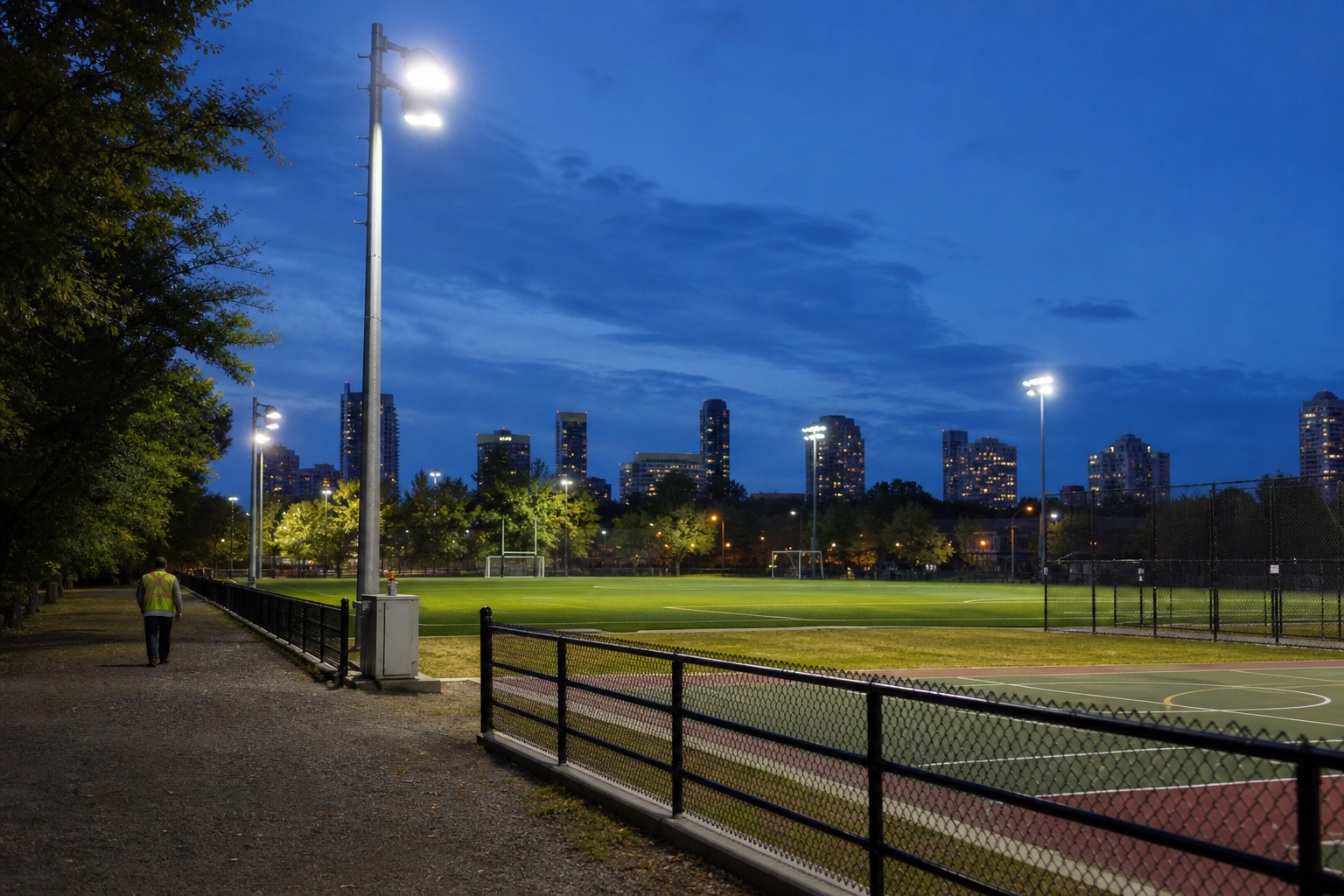
On June 5, 2026, the New York City Mayor’s Office said that sports lighting would remain on for an additional hour at 50 free and low-cost recreation locations across the five boroughs during the summer, with permitted use extended to 11 p.m. The announcement said the program would begin June 11 and run through Labor Day weekend, adding more than 4,000 hours of evening recreation. A July 17 City recap again listed the extended lighting at 50 locations and the additional play hours.
This is a defined city program. It does not announce a nationwide performance requirement, a new pole-design standard or a replacement procurement for all 50 sites. For a manufacturer or contractor, that distinction matters: the news is about the operational envelope of selected facilities, not proof that every installed pole, luminaire, control cabinet or foundation has a common specification.
Why an operating-hours decision matters to equipment planning
More scheduled evening use can change the questions a facility owner asks about controls, maintenance windows, inspection access, faults, emergency response and replacement lead time. Those are commercial and project-management questions before they become a pole order. The decision should not be used to infer a universal load, a structural condition or an electrical capacity. Responsible project parties retain those confirmations.
The NYC Mayor’s Office separately described an overnight soccer program at five locations during the World Cup period. That second program is not the same as the 50-site summer extension, but it reinforces a simple operational point: when usage hours and staffing patterns change, the owner needs a clear route for controls, site access and maintenance. Procurement documents should make that route visible instead of assuming that a product list answers it.
The jurisdiction and scope boundary
This update applies to the selected New York City facilities and dates described in the city’s notices. Other municipalities, owners and venues may have different permit hours, maintenance rules, safety procedures, controls architecture and review requirements. A buyer should use the local owner’s current documents as the governing source. Do not copy a New York operating-hour policy into another market’s project specification.
Likewise, a change in operating hours is not a declaration that a pole needs replacement. It is not evidence that a luminaire is compatible with a different mounting arrangement, and it does not settle the civil, electrical, structural, installation or authority scope. If a project is considering a physical change, connect it to the current sports-lighting pole package, issued equipment data and responsible-party review.
RFQ inputs to add when later operation is planned
The table is a practical way to prevent an operations decision from becoming an undefined equipment order. Items may be open, but they should be marked open and assigned to the party that will confirm them.
| RFQ item | Confirming party | What to make explicit |
|---|---|---|
| Operating schedule and exceptions | Controls or facilities team | State normal hours, permitted extensions, event exceptions and who authorizes changes |
| Controls, cabinets and communications | Electrical / controls team | Identify owner-furnished equipment, status reporting, remote-control requirements and access responsibility |
| Luminaire, pole and mounting status | Lighting / engineering team | Separate an operations change from a proposed fixture, mounting or pole replacement |
| Maintenance and site access | Owner / contractor | Define inspection window, isolation process, lift access, lockout route and emergency contact boundary |
| Supply, civil and installation boundary | Buyer / project manager | Quote the requested supply only; list foundation, wiring, aiming and authority work separately |
Scenario 1: confirmed controls and a defined maintenance plan
Scenario 1: a municipal owner has approved a later seasonal operating schedule for selected fields. The facility team can identify the locations, normal and extended hours, control method, responsible monitoring party, maintenance access window and the selected equipment that is already in place. If a supplier is asked to quote a replacement component or pole-side provision, the RFQ can clearly separate that supplied item from the owner’s controls, electrical distribution, civil work and operating policy. The resulting quote is comparable because its boundary is stated.
This scenario does not turn the supplier into the operating authority. It simply gives the supplier the inputs needed to discuss a proposed supplied configuration, delivery condition and review route. Where the project includes a mounting interface, the buyer should also attach the selected fixture data and follow the same discipline described in the tenon and slip-fitter RFQ guide.
Scenario 2: later use is requested but the system condition is open
Scenario 2: an owner wants extended evening use but does not know the current pole records, fixture condition, cabinet status or maintenance-access constraints. The correct RFQ does not say “upgrade the lights” and leave the rest to assumption. It identifies the known locations, marks the unknown conditions, requests any needed field verification through the responsible project path and lists a hold point before fabrication or installation.
For example, a replacement pole or adapter quotation may be useful after the project team confirms the current layout, equipment interface and design basis. Until then, a catalogue photo cannot establish the pole top, fixture loading, cable route or foundation condition. The principle is the same as for the site’s anchor-bolt and template interfaces: a controlled drawing and responsibility matrix are stronger than a remembered field detail.
How to compare proposals after an operating-policy change
Ask each bidder to identify the documents received, locations and quantity basis, equipment status, supplied components, controls assumptions, maintenance/access assumptions, exclusions and required approvals. A lower price may reflect an omitted cabinet interface, an owner-furnished luminaire, a different access assumption or no allowance for a drawing review. Those are not minor differences when the facility expects longer operational hours.
The city notices are useful dated context, but the specific project package controls the quote. Use a short comparison matrix and issue clarifications in writing. This preserves a clear separation between a supplier’s pole-side scope and the civil, electrical, installation and authority work that remains with other responsible parties.
Buyer action for the next sports-lighting RFQ
If a facility expects later operation, send the latest site layout, locations and quantities; published or requested operating window; selected versus pending equipment; controls/cabinet status; known access and maintenance route; material/finish direction; scope boundary; and required project review stage. Start with the broader light-pole RFQ checklist, then add the operating details that affect the actual field program.
FAQ
Did New York City announce a universal sports-lighting standard?
No. The announcement is a New York City summer operating and permit policy for selected sites. It is not a universal pole, luminaire, structural, electrical or authority specification.
Does a later operating schedule mean existing poles can be reused without review?
No. An operating-hours decision does not verify a pole, mounting, controls, electrical system or maintenance arrangement. Responsible project parties must confirm any proposed modification against current project information.
What should an RFQ say when a sports field will operate later?
State the intended operating window, selected versus pending equipment, control/cabinet status, maintenance and access route, known site interfaces, supply boundary and the required review process.
Turn an operating change into a clear RFQ
Send the field locations, operating schedule, equipment status, control and cabinet information, maintenance/access route, known interfaces and review requirements. Fortune Light Pole can discuss a proposed supplied configuration against that project information.
Open RFQ Form
Leave a Reply