Verified infrastructure update · August 2026 analysis
Menifee 2026 Sports-Field Lighting: RFQ Boundaries Before Installation
Menifee’s public program and project records provide a project-specific reminder for athletic-field lighting buyers: a public update can guide RFQ questions, but only the issued package can define the supplied pole, electrical and civil interfaces.

What the 2026 public records actually confirm
The City of Menifee’s current social-infrastructure page lists separate sports-lighting capital items for E.L. Pete Petersen Park and Hidden Hills Park. Each is shown as a $400,000 pre-construction item with an anticipated Fall/Winter 2026 completion window. That is current owner-side program information: it confirms that the City is moving distinct park lighting packages toward construction, but it is not a universal product specification or a released fabrication drawing.
California’s public CEQA record for E.L. Pete Petersen Park gives a more specific project description. It identifies four new 60-foot light poles carrying a total of 20 LED fixtures within the existing park, plus one 30-foot pole near the basketball court. The record also states that the lights are to be shielded to address off-site light leakage and turned off at 9:00 p.m. These are project facts for that site; they do not establish a transferable shaft, loading, base detail, controls package or foundation design for another athletic-field owner.
Why the project boundary matters before quoting poles
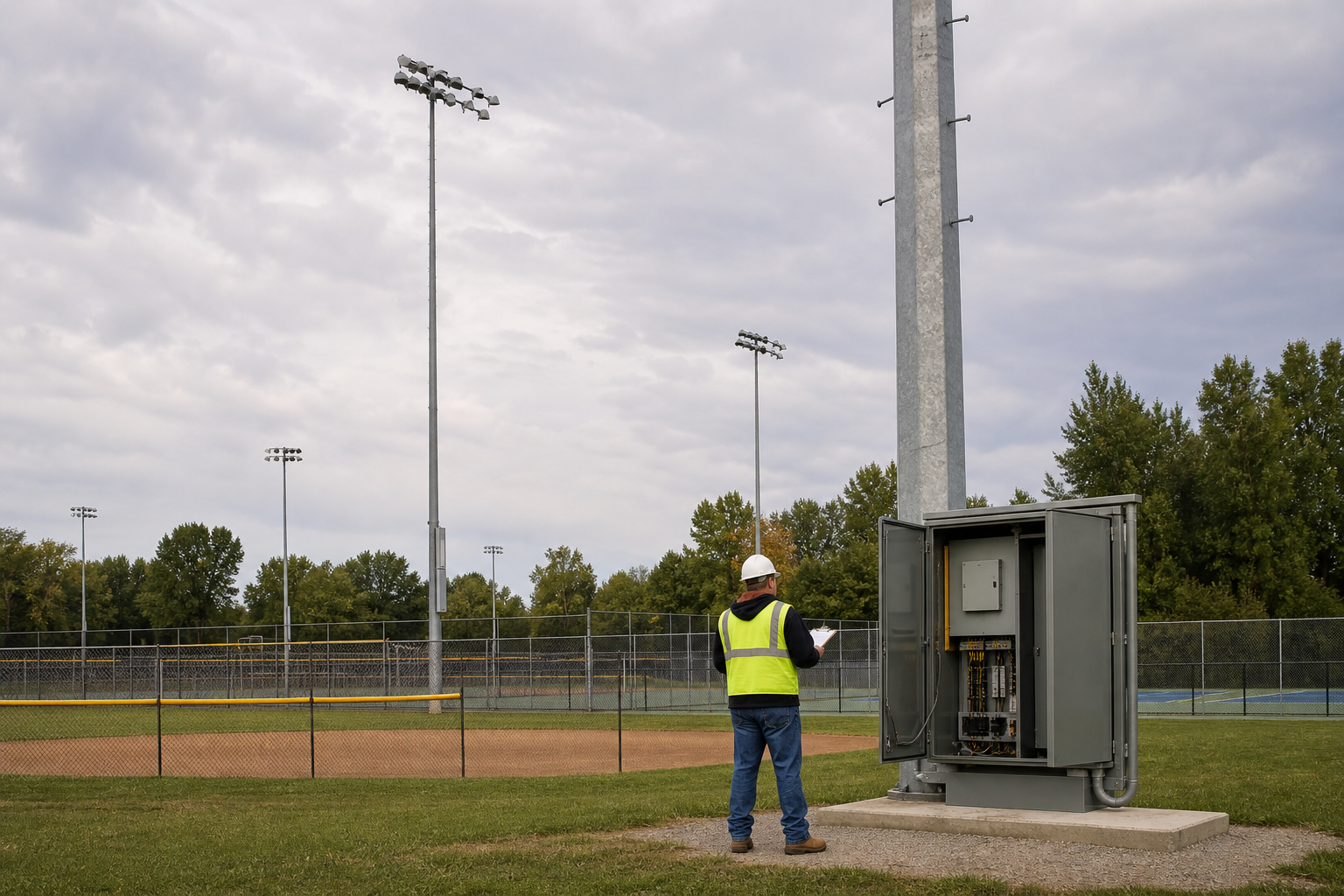
A public phrase such as “lighting upgrade” can cover more than one procurement interface. For a field package, the responsible team still needs to identify the issued field layout, pole marks and quantities, selected or pending luminaires, mounting arrangement, controls interface, known cable route, access constraints, finish, delivery point and review path. The supplied pole package should be described separately from civil work, electrical connection, commissioning, installation, permits and acceptance unless the contract expressly assigns those items to the same party.
This boundary protects both buyer and supplier. It lets a manufacturer return a defined pole-side proposal with assumptions and open items, rather than silently pricing unissued equipment or a foundation concept. It also stops a project team from treating an indicative image, a previous field or a generic catalogue shaft as an approved interface. The result is a comparison based on the same pole marks and document revision, not a headline label.
What the published project detail does not settle
The public record describes pole count, nominal height, fixture count, shielding intent and an operating constraint for the E.L. Pete Petersen Park work. It does not publish a pole schedule by mark, luminaire model, photometric calculation, fixture projected area, mounting geometry, base and anchor-bolt drawing, soil condition, conduit layout, cabinet detail or installation sequence. Those interfaces should not be inferred from a project summary, a park photograph or another supplier’s catalogue image.
Menifee’s program page also names two separate parks. A buyer should not copy the E.L. Pete Petersen Park facts into Hidden Hills Park—or treat the same nominal sport-lighting phrase as proof of equivalent scope. Location, existing conditions, pole marks, power route, controls, access and authority review may all differ. The procurement lesson is to keep every pole, field and equipment interface tied to the exact issued package.
RFQ inputs to request before a field-lighting release
Send every bidder the latest issued layout and document register. Identify field name or zone, pole marks, quantities, existing versus new work, finished-grade information available, luminaire schedule and mounting data, selected versus pending equipment, known cabinet/control interface, cable and conduit information available, intended maintenance access, finish, packaging, delivery location and required review deliverables. Where an input is not issued, label it as open and name the party that will close it.
Ask each supplier to state the document revision used, supplied accessories, exclusions, assumptions and any information required before fabrication. The site’s athletic-field lighting RFQ guide, lowering-system input guide and anchor-bolt and template guide can structure that record. They do not replace the project engineer, electrical designer, authority requirements or approved drawings.
| RFQ check | What to identify | Who confirms |
|---|---|---|
| Issued field scope | Current field plan, pole marks, fixture schedule, control intent and every known revision | Owner / design team |
| Pole-side supply | Shaft, base plate, specified mounts, access provisions, finish, packing and stated exclusions | Supplier |
| Below-grade and electrical boundary | Foundation detail, soil/civil work, conduit, power, controls, grounding and field wiring | Assigned civil / electrical parties |
| Separate site package | Parking-lot or solar-light records that are not part of the athletic-field upgrade | Owner / procurement team |
| Release control | Document revision, field verification, reviewer and condition for fabrication release | Responsible project parties |
Scenario one: an issued municipal field retrofit
In a released retrofit scenario, the municipality issues a field plan, pole list, selected luminaire and mounting package, known control-cabinet boundary, required finish and review route. The RFQ separates pole supply and named hardware from demolition, foundations, conduit, wiring, field installation and commissioning. A supplier can respond with a traceable configuration, identify included mounts or access provisions, and flag any site verification that remains necessary.
The buyer then compares proposals against the same information set. If one proposal includes a crossarm or access provision and another excludes it, the difference is visible instead of being buried in a total. If a control change affects a mounting interface, the project team can update the document register and return that pole mark for review before a manufacturing release.
Scenario two: an early upgrade plan with open interfaces
In an early-phase scenario, an owner knows that field lighting is being upgraded but has not finalized fixture selection, pole locations, a future camera provision, control architecture or the maintenance approach. A preliminary RFQ can still establish a commercial range if it explicitly labels those inputs as provisional. It should not be presented as permission to fabricate a final support package.
The next review closes the selected versus pending equipment list, approved mounting locations, cable/control boundary, access needs, field verification responsibility and the document revision that governs release. This is more credible than instructing a supplier to “match the existing field.” It creates a decision point before material is committed and keeps later civil, electrical or operating changes from being disguised as a small pole variation.
Use the news item as a document-control prompt
Menifee’s program is valuable because it shows a public owner moving more than one athletic-lighting package toward construction while a public project record separately identifies site-specific physical constraints. The practical action for another buyer is not to reuse Menifee’s heights or operating rule. It is to use the event as a reminder to map every scope boundary before procurement: which package governs, which equipment is selected, what is supplied with the pole, what stays with other trades, and who gives final release.
For a project-specific discussion, send the latest issued drawings, quantities, equipment and interface record through the RFQ form. Fortune Light Pole can review a proposed supplied pole configuration against those inputs while the responsible project parties retain the design, civil, electrical, installation and authority decisions.
Frequently asked questions
Does the Menifee record establish a universal athletic-field pole specification?
No. It is a site-specific City program and California public-project record. A buyer should use the current drawings, specifications, selected equipment and approvals assigned to the buyer’s own project.
Can the published 60-foot and 30-foot pole references be copied into another field RFQ?
No. Those facts describe the E.L. Pete Petersen Park project. They do not determine another site’s layout, luminaire load, foundation, controls, access or authority requirements.
What should a supplier receive before fabricating an athletic-field pole package?
The issued layout and pole schedule, selected or pending luminaire and mounting data, known control and cable interfaces, scope split, finish, delivery, review path and every open item with a responsible confirming party.
Prepare a controlled athletic-field lighting RFQ
Send the issued layout, pole schedule, luminaire and mounting data, known control and cable interfaces, scope split, finish, delivery and review stage. Mark open items so a proposed supplied configuration can be reviewed clearly.
Open RFQ Form
Leave a Reply