B2B sports-lighting procurement guide
Sports Lighting Pole Lowering Systems: RFQ Inputs for Maintenance Access
Short answer: when a sports-lighting project specifies a lowering system, the RFQ needs to describe the whole maintenance interface: the pole, luminaire carriage, controls, electrical isolation boundary, access area, supplied items and review status. A pole height and fixture count alone do not establish a complete proposal.

A sports field can look straightforward from the fence line: a group of high poles, a set of floodlights and a control point. The procurement package becomes more complex when the owner wants maintenance to take place from a lower, controlled service position instead of using a separate elevated-access method. That choice can change the pole-side equipment, wiring route, carriage arrangement, control enclosure, site clearance and handover information. It should be described as an interface, not as a generic feature added after the main pole decision.
This guide helps owners, contractors, consultants and procurement teams prepare a clearer B2B RFQ for a sports lighting pole with a specified lowering system. It does not prescribe a universal structural, foundation, electrical, operating or authority requirement. Those decisions remain with the responsible project parties and the applicable local requirements. The practical goal is to make the confirmed scope and open items visible before a supplier is asked to quote.
Define the lowering-system interface before selecting a pole
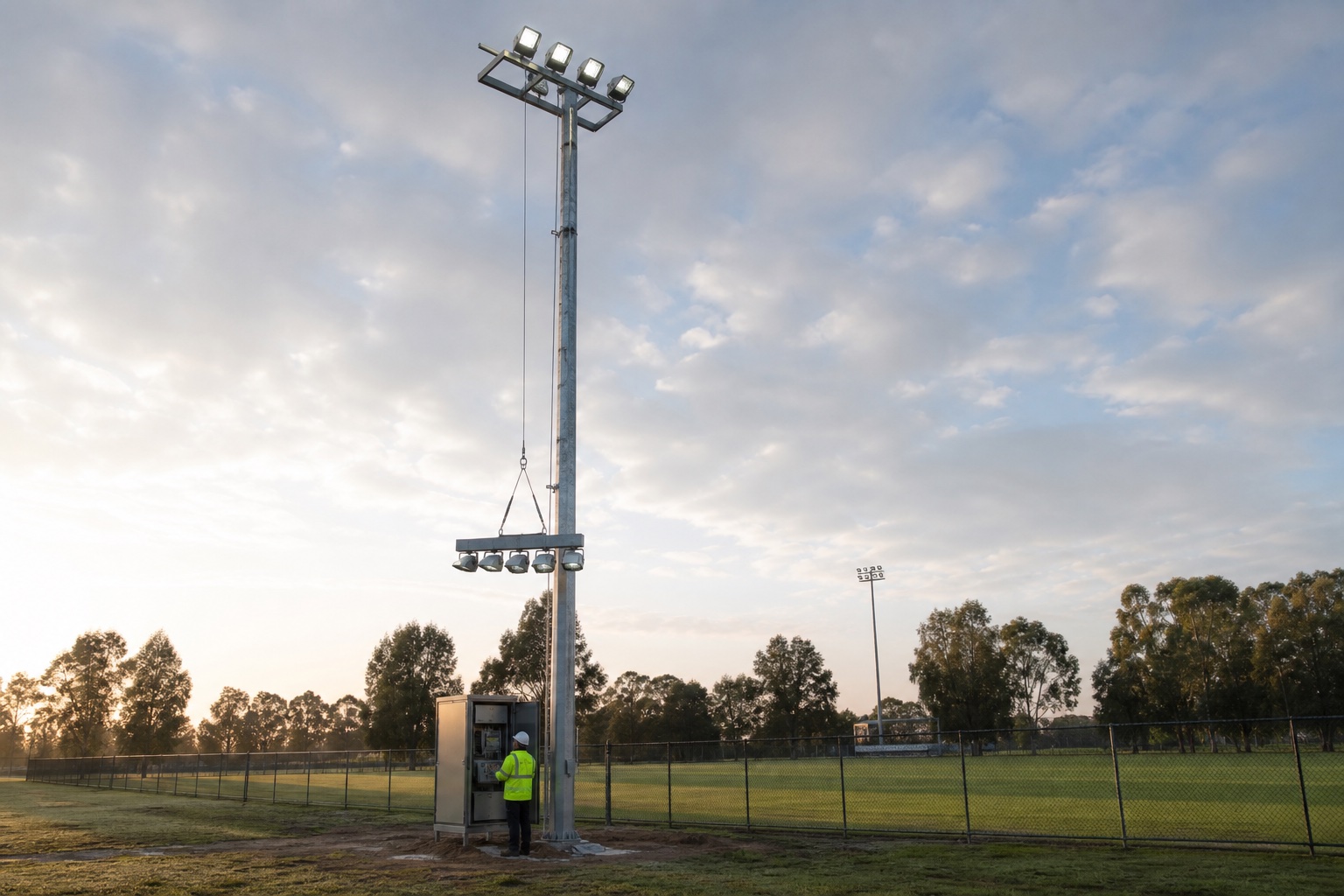
“Lowering system” is not enough information by itself. In one project it may mean a defined luminaire carriage brought to service level; in another, the phrase may be used loosely while the designer still has to determine the mounting, equipment and maintenance method. Start by asking what is actually to be lowered, which equipment remains on the pole, which equipment is ground-level, and how the project expects the service position to be used.
The current lowering-system sports lighting pole product page can help name the product family, but it should not override the field layout or issued project documents. The final supplied configuration follows the confirmed project package. A quotation becomes more comparable when every bidder is responding to the same carriage, fixture, control and access description.
Start with the field layout and luminaire schedule
The issued field layout establishes more than quantities. It tells the project team which play areas, fencing, spectator zones, service paths and adjacent buildings influence the installation sequence. Pair it with the luminaire schedule and aiming information. The RFQ should identify fixture count by pole, the mounting arrangement, known weight and effective projected area data where supplied, electrical/control interfaces, and any limitation on the maintenance area.
Do not replace this package with a catalogue photograph. A photograph cannot say whether the project uses one carriage or several, whether luminaires are owner-supplied, whether controls are separate, or which party supplies circuit protection and cabling. Where a supplier is asked to review a proposed pole-side configuration, the request should explicitly distinguish that review from electrical, civil, structural, installation and authority responsibilities retained by the responsible parties.
RFQ inputs that materially change the proposal
The table is a control list, not a design standard. It lets the buyer show what is issued, what is provisional, and what needs a named confirmation before release.
| RFQ input | Why it matters | Confirming party | Quotation treatment |
|---|---|---|---|
| Field layout, pole locations and quantities | Connects each pole to the physical site and service area. | Project designer or contractor | Price by location and identify any unresolved position. |
| Luminaire, carriage and mounting information | Defines the equipment interface and proposed pole-side arrangement. | Lighting designer / equipment owner | Include confirmed supplied items; list owner-supplied or pending items. |
| Lowering, winch and control concept | Clarifies what moves, what stays fixed and who operates the system. | Responsible project party | Reference issued information; do not assume a generic mechanism. |
| Power, control and isolation boundary | Separates pole supply from electrical work and safe-work procedures. | Electrical contractor / engineer | State known interfaces and exclusions clearly. |
| Maintenance area and access limitations | Affects service sequencing and site coordination. | Owner / contractor / operator | Record constraints rather than implying they are resolved. |
| Submittal, review and release route | Sets the required drawing and confirmation path. | Contractor / authority | Show the documentation included in the agreed scope. |
For project-wide context, the Sports Lighting category and the site’s engineering support page are useful starting points. They do not turn an open project condition into a confirmed requirement. The useful RFQ retains the drawing number, revision and owner of each open item.
Scenario one: a municipal field replacement with a defined service area
Example: a municipality is replacing lighting at an existing multi-use field. The issued layout identifies pole locations and a fenced service area; the luminaire schedule and carriage arrangement are already fixed. The electrical contractor owns incoming power and local isolation, while the pole supplier is asked to quote the agreed pole-side system and submittal package. The RFQ can be specific: quantities by location, mounting data, finish, maintenance-zone restrictions, target delivery sequence and the review route.
That does not eliminate all coordination. The buyer should still identify who confirms the field access schedule, control cabinet location, cable interface, delivery path and final acceptance. But a proposal built from this record can separate supplied components from contractor work. It is more reliable than a price based only on “four high-mast poles with lowering.”
Scenario two: an upgrade where the lighting equipment is still being selected
Example: a school district has a preliminary field layout but has not completed fixture selection or the final electrical-control package. The team wants an early budget indication and needs to know what information will affect the final order. In this case, the RFQ should request a controlled preliminary proposal and an open-items register: provisional luminaire data, pending carriage design, control interface, maintenance access, final pole locations, foundation responsibility and release date.
This gives the buyer a commercial planning tool without disguising unknowns as approvals. A supplier can explain which supplied interfaces can be discussed from the information available and which need the responsible project parties to close first. It also reduces the risk that a later fixture or access change is treated as a minor detail when it actually changes the agreed pole-side scope.
Separate pole supply from electrical, civil and operation scope
For maintenance work near electrical equipment, project teams should follow their applicable rules and procedures. The U.S. Occupational Safety and Health Administration’s control-of-hazardous-energy rule and electrical work-practices rule are official U.S. references. They are not a sports-pole specification and may not govern projects outside their jurisdiction; they illustrate why the RFQ should name the electrical and safe-work boundaries instead of leaving them implicit.
Ask each bidder to state whether its supply includes the pole, lowering equipment, carriage, fixture brackets, pole-side wiring, control enclosure, operating device, anchors or templates, drawings, packing, delivery support or other agreed items. Then list what remains with the civil, electrical, structural, installation and site-operation parties. This makes it easier to compare proposals without treating an exclusion as a defect or an assumption as an included service.
Compare quotes through a controlled release sequence
A release sequence keeps procurement moving while protecting the project from an accidental early fabrication release. The same order of questions also helps the team compare suppliers on actual scope, documentation and lead-time assumptions.
| Stage | Project package | Supplier response | Release condition |
|---|---|---|---|
| RFQ issue | Layout, quantities, known equipment data and maintenance intent. | Commercial proposal, assumptions and clarification questions. | Open items are logged. |
| Technical alignment | Clarifications from responsible project parties. | Proposed supplied configuration against the issued inputs. | Scope and interfaces are controlled. |
| Submittal review | Final fixture/carriage data and review route. | Agreed drawings and documentation within supply scope. | Responsible reviewers complete their process. |
| Fabrication release | Approved release data and change owner. | Production schedule for agreed supplied items. | Pending items are not treated as approval. |
| Delivery and handover | Site sequence, unloading and installation interfaces. | Packing and delivery information for the pole supply. | Operating and maintenance responsibilities remain assigned. |
Use this sequence with the RFQ form: attach the current documents, say which stage the project is in, and name the parties who will close any remaining items. This produces a better technical conversation than asking for a fixed quote from an incomplete equipment list.
What to send for a maintenance-access RFQ
Send the latest layout, pole schedule, quantities, luminaire and mounting information, lowering-system concept, known controls and power interfaces, project location, access constraints, finish direction, delivery requirement, review route and any issued drawings. If a condition is not yet known, label it as pending and identify the party who will confirm it. Also state whether the request is for a preliminary budget proposal or a release-ready supply quotation.
Fortune Light Pole can discuss a proposed supplied configuration against the information provided, identify commercial clarification items and prepare a quotation for the agreed supply scope. The responsible project parties retain confirmation of structural, civil, electrical, installation, operating and authority requirements. That boundary is particularly important where a lowering arrangement changes maintenance access but does not eliminate the wider project coordination.
Frequently asked questions
What should be included in a sports-lighting pole lowering-system RFQ?
Send the current field layout, pole schedule, luminaire and carriage information, maintenance concept, control and power interface notes, project location, quantity, finish, review route and any issued drawings. Mark pending items and name the responsible party who will confirm them.
Does a lowering system remove every maintenance responsibility?
No. A specified lowering arrangement can change access to a defined luminaire carriage or fixture assembly, but the project team still confirms safe work procedures, electrical isolation, site access, inspection and authority requirements for the particular installation.
Can a supplier quote before the final field layout is approved?
A preliminary proposal can be useful when it distinguishes confirmed supply from assumptions and open items. The final configuration, quantity, interfaces and release documents should be controlled before fabrication is authorized.
Next step: send the current sports-lighting package
Prepare a clearer maintenance-access RFQ
Share the field layout, quantities, luminaire and carriage details, known controls, access constraints, drawings and review stage. We will identify commercial questions and propose an agreed supply scope.
Primary sources
- OSHA 1910.147: The control of hazardous energy (lockout/tagout) — official U.S. reference.
- OSHA 1910.333: Selection and use of work practices — official U.S. reference.
Leave a Reply