Verified industry update · Alaska · August 2026
Kenai Spur Highway Lighting Work: RFQ Interfaces Before Foundation Installation
Short answer: Alaska DOT&PF’s current Kenai Spur Highway update makes one project fact clear: roadway-lighting work is moving through conduit, junction-box and pile-driven foundation activity. For a supplier RFQ, the useful response is not to copy a public update as a universal specification; it is to confirm the issued layout, pole schedule and civil/electrical interfaces before a pole-side supply package is released.

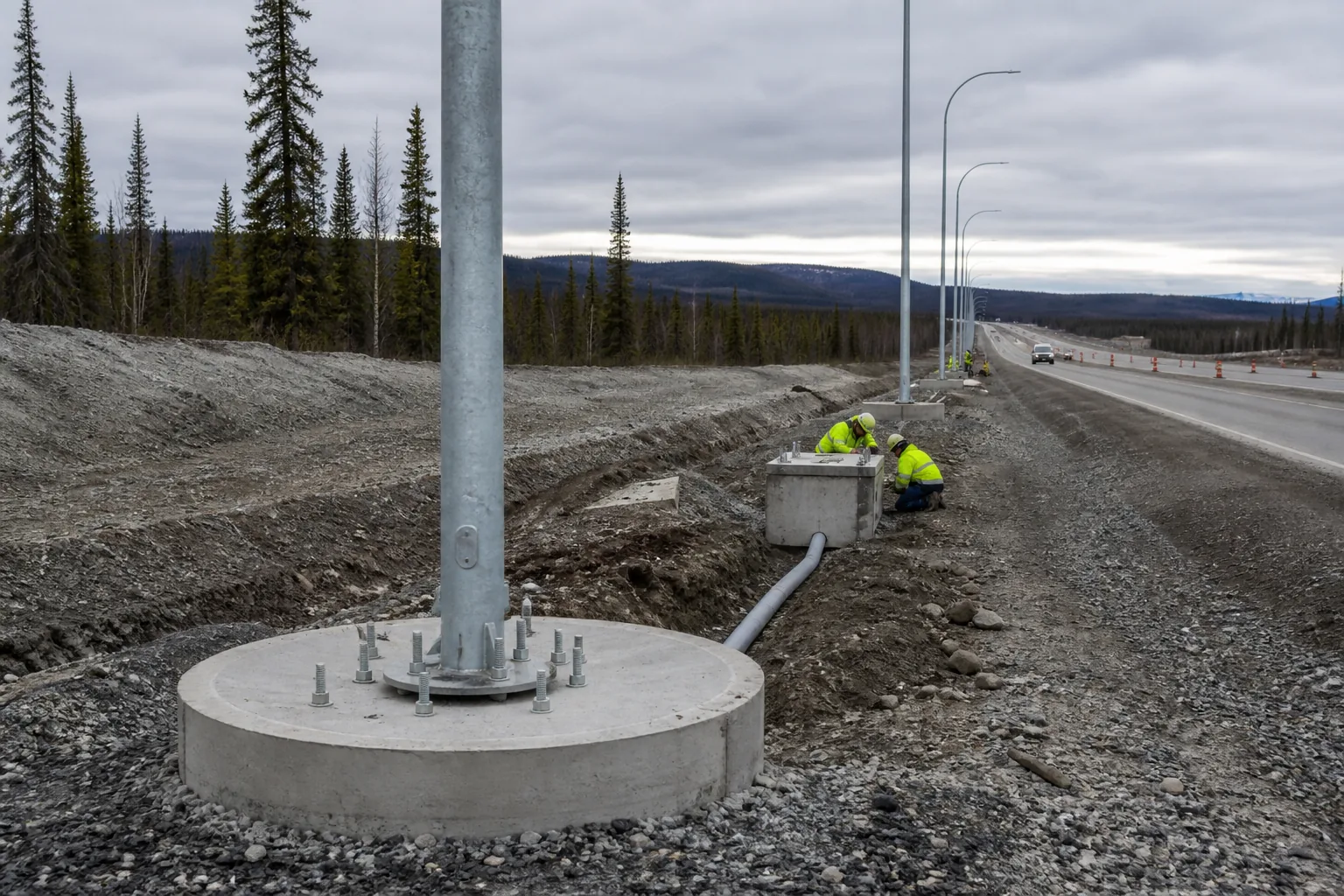
On July 23, 2026, the Alaska Department of Transportation and Public Facilities (DOT&PF) reported that lighting electricians would begin work in early August on conduit, junction boxes and pile-driven lighting foundations along the Kenai Spur Highway project. The same update describes continuous lighting between Delta Avenue and Dolly Varden Street. An earlier DOT&PF contract announcement identifies the larger Sports Lake Road-to-Swires Road corridor project and its roadway improvements. These are useful, current project facts. They are not a dimension, wind-load, foundation, electrical or approval standard for unrelated work.
What has changed on the Kenai Spur Highway corridor
The current public update places the roadway-lighting package in a field sequence where civil and electrical interfaces matter. Conduit routes, junction boxes and lighting foundations have to be coordinated with the project layout and the construction programme before poles and luminaires can become a release-ready supply package. Public reporting also notes ongoing road rehabilitation and traffic-management activity, which reinforces that lighting work is one part of a broader corridor programme.
For procurement teams, that is a practical timing signal. A pole quotation cannot responsibly assume that every foundation, cable route, junction-box location or installation handoff is final simply because field activity has started. The current controlled documents—layout, pole schedule, detail drawings, quantities and contractor instructions—remain the commercial reference. The Roadway Light Poles category can help identify the relevant product family, but it does not substitute for the released project package.
Where the project boundary matters most
Roadway-lighting procurement crosses several scopes. A pole manufacturer may price a shaft, base plate or other agreed pole-side items; a civil contractor may execute foundations; an electrical contractor may handle conduit, cable, junction boxes and connections; the responsible designer and authority retain their review roles. Those distinctions should stay visible in the RFQ. A public construction update should never be used to assign unseen scope to a supplier.
The point is especially important when issued information is incomplete. Rather than selecting hardware from a prior corridor or catalogue image, list the open item, identify the drawing revision and name the party who will confirm it. This gives bidders a common, auditable basis for clarification and prevents a commercial proposal from being mistaken for a final civil or electrical design.
Inputs to confirm before a foundation-related RFQ release
A compact RFQ register is more useful than a long general description. The following inputs help a buyer separate confirmed project information from items that still require review.
| RFQ input | Why it matters | Confirming party | Quotation treatment |
|---|---|---|---|
| Current layout, pole marks and quantities | Connects every supply item to the actual corridor and work sequence. | Designer or contractor | Quote by issued mark; list missing or revised locations. |
| Luminaire, mast-arm and mounting information | Defines known equipment interfaces at the pole. | Lighting designer / equipment owner | State confirmed supplied items and pending interfaces. |
| Base, anchor and foundation detail | Prevents a public project reference from being treated as a universal foundation selection. | Responsible civil / structural parties | Reference issued detail and explicit scope boundary. |
| Conduit, junction-box and cable interface | Clarifies what reaches the agreed handoff and what remains electrical scope. | Electrical contractor / engineer | List known interfaces and exclusions clearly. |
| Submittal, review and delivery route | Controls drawings, timing and change management. | Contractor / authority | Show document revision, assumptions and release conditions. |
For related commercial preparation, buyers can review anchor-bolt and template RFQ inputs and fixture and mast-arm data to send with an RFQ. These guides help organise an enquiry; the responsible project parties still confirm the actual foundation, electrical and authority requirements.
Scenario: the issued corridor package is ready for comparison
Example: a contractor has the current roadway layout, pole schedule, issued base detail, luminaire information and an agreed interface drawing showing where conduit and junction-box work reach the pole location. The RFQ asks bidders to identify the supplied pole-side items, finish, quantities, submittal route, packing and delivery timing. Civil and electrical work are stated separately.
In that situation, suppliers can provide comparable commercial responses because the known interfaces are attached to the right locations and document revisions. A supplier can flag any commercial clarification without pretending to approve the foundation or electrical design. The buyer can then compare scope, lead-time assumptions and included documentation rather than comparing only an isolated pole description.
Scenario: field activity has begun but equipment decisions remain open
Example: a corridor has begun preliminary conduit or foundation work, but a revised luminaire, mast arm, cabinet interface or final pole schedule is still under review. The RFQ should not force a release-ready pole configuration from incomplete information. Instead, the buyer can request a preliminary proposal that states the current document set, the provisional items, the confirmation owner and the point at which the quote must be updated.
This approach supports schedule discussions while keeping change control visible. It also avoids a common mismatch: civil work is progressing, while a supplier has priced an assumed pole-side arrangement that no responsible party has issued or approved. The project team owns the decision to close that gap; the supplier records what its proposal relies on.
Use the update as a document-control prompt, not a generic rule
Alaska DOT&PF’s update is jurisdiction- and project-specific. It is relevant because it shows how lighting foundations, conduit and junction boxes appear in a real roadway programme, not because it establishes a transfer-ready specification. Buyers outside this corridor should look to their own issued plans, authority requirements and responsible review process. Even on the same corridor, a later issued revision may supersede a public webpage.
The best procurement action is therefore simple: keep a document register. Attach the latest layout, pole schedule, equipment information, known civil and electrical interfaces, drawing revisions and review route. Mark unconfirmed items separately. The engineering support page and the Knowledge Center can help frame questions, but neither replaces a project’s governing documents.
How to compare proposals before release
Compare quotations by the agreed supply boundary: pole shaft and mounting configuration, specified accessories, finish, known base or anchor data, documentation, packing, delivery and stated exclusions. Check whether the proposal treats conduit, cable, junction boxes, foundations, installation, testing or authority coordination as included, owner-supplied, another contractor’s work or pending review. A difference in that list is often more consequential than a difference in the headline description.
Before release, review the schedule, issued drawings, pole marks, equipment interfaces, document revision, submittal route and responsible parties together. If any of them remain open, record them. That makes the RFQ useful to the buyer and fair to suppliers without implying that a commercial proposal has resolved a civil, electrical, structural or authority decision.
Frequently asked questions
Does the Kenai Spur update prescribe a standard pole or foundation?
No. Alaska DOT&PF’s project update describes work on this corridor. It does not replace the issued project documents, responsible design review or local authority requirements for another project.
What should be sent before a roadway-lighting foundation quotation?
Send the current layout, pole schedule, quantities, luminaire and mounting information, known conduit and junction-box interfaces, base or anchor detail if issued, civil and electrical scope boundary, document revision and required review stage.
Can a pole supplier finalize civil or electrical design from a public project update?
No. A supplier can discuss a proposed supplied configuration against the information provided. The responsible project parties confirm civil, structural, electrical, installation, safety and authority requirements.
Prepare a clearer roadway-lighting RFQ
Send the latest layout, pole schedule, luminaire and mounting information, known base and conduit interfaces, document revision, quantities and review stage. We can discuss a proposed supplied configuration and identify commercial clarification items against the information provided.
Primary sources
- Alaska DOT&PF: Kenai Spur Highway construction update — July 23, 2026 project update.
- Alaska DOT&PF: Kenai Spur Highway contract announcement — project and corridor context.
- Alaska DOT&PF: Kenai Spur Highway FAQ — public project context and boundaries.
Leave a Reply