Light pole fabrication RFQ guide
Light Pole Welding: What Buyers Should Review Before RFQ
A welding question is rarely answered by “yes, we can weld it.” Buyers get a clearer review when they connect the joint to the material, geometry, loading, finish, drawings and documentation required for the actual project.
This is a procurement checklist. It does not certify a weld, select a governing code or replace project-specific engineering and inspection.

The short answer: review the weld as part of the whole configuration
A light-pole weld cannot be evaluated from the word “welding” in a quotation. The useful questions are what is being joined, which material and thickness are involved, what the drawing calls for, which project rules apply, how the connection is loaded and what documentation is expected before release.
The American Welding Society describes a welding procedure specification (WPS) as the document that sets required welding variables for a particular application. A procedure qualification record (PQR) is supporting qualification documentation. Whether either is required, and in what form, comes from the applicable code, contract and project review—not from a generic blog post.
Buyer question
Which joint, material, drawing and acceptance requirement does this RFQ actually cover?
Engineering question
Which loading, shaft geometry, arm/bracket interface and material details affect the design review?
Document question
Does the project request a preliminary quote, a review drawing, a WPS/PQR submission, inspection records or final release documents?
What a real factory photo can—and cannot—show
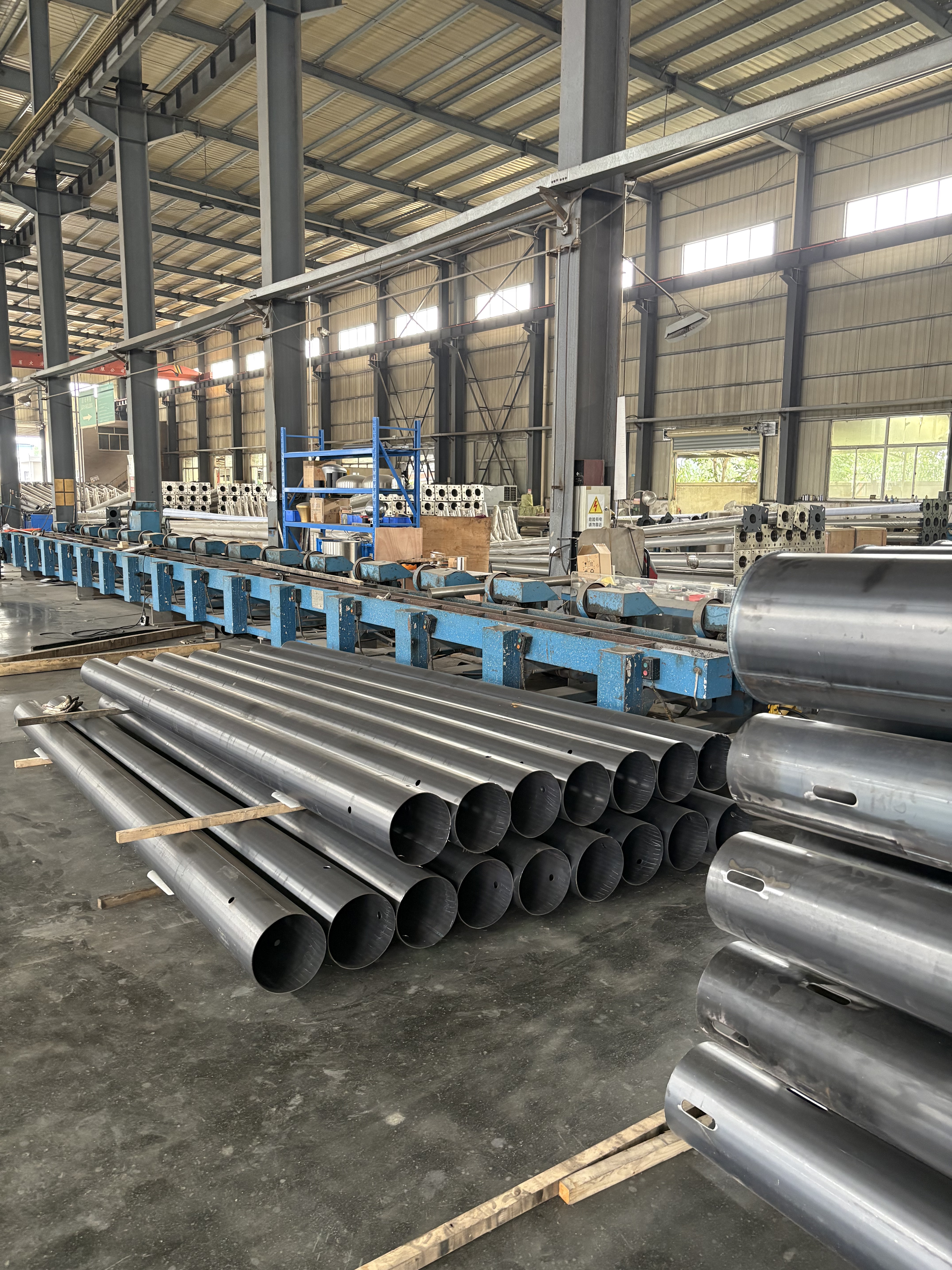
The photo above is an actual factory-floor view of steel light-pole sections and fabrication equipment. It helps a buyer understand that pole production involves material handling, formed or tubular sections, interfaces and factory workflow.
It does not prove the welding process used on a specific pole, the qualification of a procedure or operator, the dimensions of a joint, an inspection outcome, material traceability, acceptance under a code or suitability for an unknown loading case. Those conclusions require the project documents and appropriate records.
| Useful photographic evidence | General manufacturing environment, visible product form, handling context and the fact that the image is a real facility view. |
|---|---|
| Evidence a photo cannot replace | Approved drawings, material certificates, WPS/PQR where required, inspection reports, dimensional records, coating/finish records and project approvals. |
| RFQ action | Ask which documents are required at quotation, drawing-review and production-release stages. |
WPS and PQR in plain language
A WPS identifies the variables for a defined welding application so production welding can be performed consistently under the applicable requirements. AWS materials explain that procedure and performance qualification involve the relationship between the base material, process, filler material, joint and supporting records.
A PQR supports procedure qualification. It is not a marketing attachment and it is not automatically transferable to every pole configuration. If your tender or specification requires WPS/PQR documentation, provide the governing references and the actual joint/material details early enough for a meaningful review.
| WPS | The specified welding variables and instructions for a defined application. |
|---|---|
| PQR | Supporting record used in procedure qualification, when required by the applicable rules. |
| Welder/operator qualification | A separate question from the WPS itself; confirm the requirement and record format in the project specification. |
| Inspection record | A project record describing the required examination, acceptance criteria and result; do not infer it from a product image. |
Six RFQ inputs that make the welding discussion specific
An RFQ can start with unknown items, but unknowns should be named rather than silently assumed.
1. Material and thickness
Identify the requested material grade or direction, wall/thickness information if available, and whether the material is fixed or subject to engineering review.
2. Joint and geometry
Attach the shaft, arm, bracket, base or accessory drawing. Mark the joint location, access constraints and any special geometry.
3. Loads and environment
Share luminaire/device weight and EPA, arm reach, wind input, vibration or fatigue considerations where the project specification provides them.
4. Applicable requirements
State the governing code, customer standard, tender clause, authority requirement and any required approval route. Do not cite a code name without the relevant project scope.
5. Inspection and documents
Specify requested visual examination, NDT, dimensional checks, WPS/PQR, material records, photographs, reports or hold points—only as applicable to the project.
6. Finish and delivery stage
State galvanizing, coating, polishing or other finish direction and when it occurs in the confirmed sequence; identify the required document stage before shipment.
Questions to ask when reviewing a pole drawing
The drawing should turn an abstract welding request into an identifiable manufacturing interface.
| Joint location | Can the reviewer identify where the shaft, arm, bracket, base, access detail or attachment is joined? |
|---|---|
| Reference dimensions | Are diameter, thickness, length, angle, orientation and relevant connection dimensions clear enough for the stated review stage? |
| Material direction | Does the drawing state the material requirement or clearly identify it as an item to be confirmed? |
| Equipment schedule | Are luminaire, camera, signage, solar or communications loads represented, including their mounting faces and interfaces? |
| Finish sequence | Does the project state the intended finish and its relationship to fabrication and delivery requirements? |
| Open approval items | Are code, procedure, inspection, structural and authority decisions labelled for confirmation instead of implied? |
Avoid these common shortcuts
Good procurement language reduces the chance that a factory capability statement is mistaken for project approval.
“Welded steel pole” is not a complete specification
Add material, wall/thickness direction, shaft shape, joint drawing, equipment data and the applicable project requirement.
A procedure name is not a final approval
A WPS/PQR question still needs the governing code, application, material and joint details to be reviewed in context.
Visual appearance is not an inspection result
A clean-looking product photo does not establish conformity, internal condition or acceptance against an unspecified criterion.
Finish should not be an afterthought
State the corrosion environment and intended finish route so the final production and documentation discussion is connected.
Related product and engineering paths
Use these pages to connect a welding question to the actual pole system, loading inputs and material/finish direction.
Source references
These AWS resources support the general distinction between procedures, qualification records and inspection documentation. They do not determine the requirements for a particular light-pole project.
FAQ
What is a WPS for light pole welding?
A welding procedure specification, or WPS, is a document that sets the welding variables for a defined application so work can be repeated under the applicable requirements. The project must identify the governing code, material and joint conditions.
Is a factory photo proof of light pole weld qualification?
No. A factory photo can show general fabrication context, but it does not establish a procedure qualification, weld acceptance, inspection result, material traceability or compliance for a specific project.
What should a light pole welding RFQ include?
Include material and thickness, shaft and arm geometry, joint details, drawings, applicable code or client specification, requested WPS/PQR or inspection records, finish system, loading data and the required document stage.
Can a supplier quote before final welding documents are complete?
A preliminary quote can begin with open items if they are stated. The final drawing, procedure, inspection and production requirements should be confirmed through the applicable project review before release.
Send a Welding-Review RFQ
Share the application, material and geometry, drawings, luminaire or device loads, arm/base interfaces, site data, required code or client specification, requested documents, finish direction and current project stage.
Leave a Reply