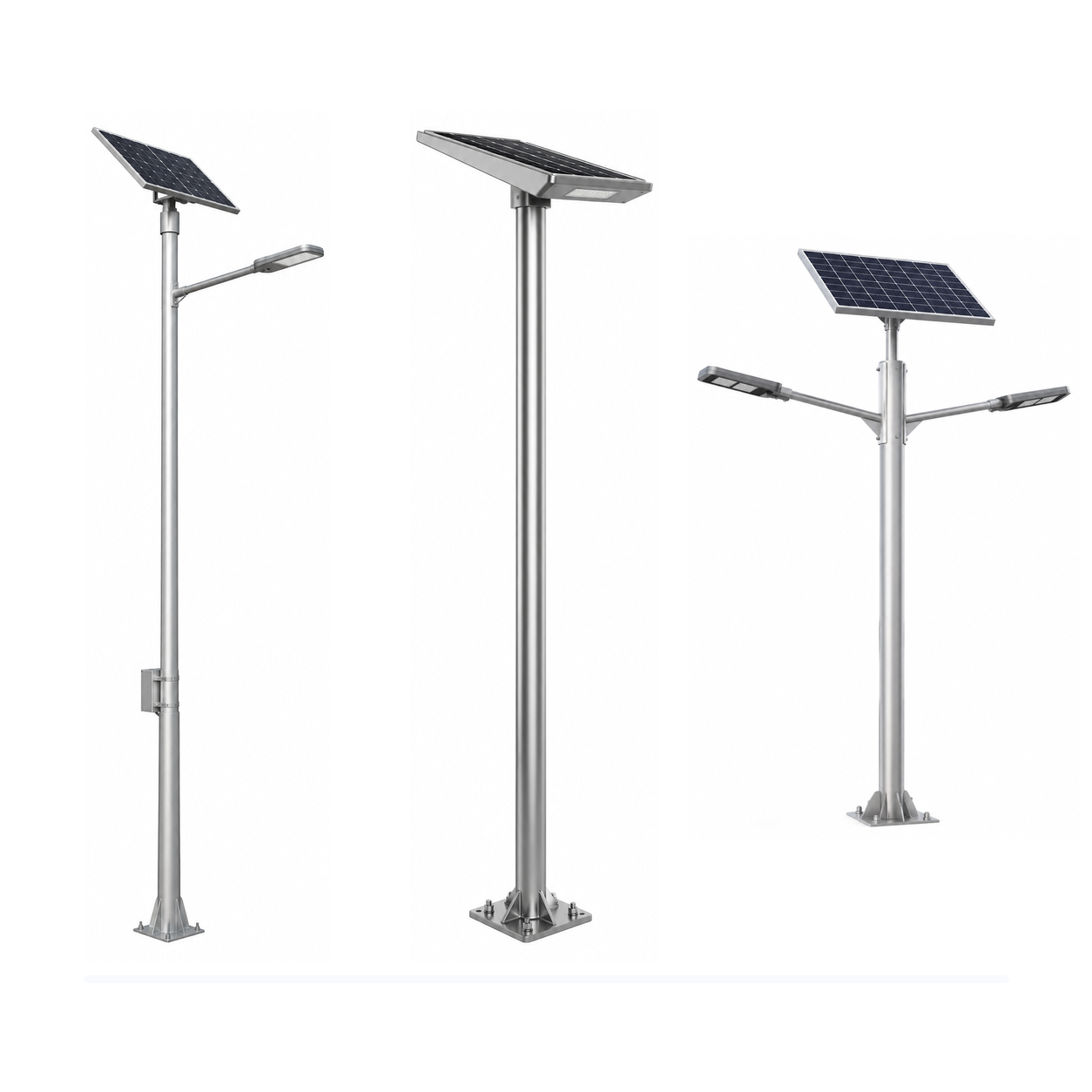
Solar light pole specification
How to Specify Solar Light Poles for a Project
A useful solar light pole RFQ should define the site, lighting target, solar panel, battery, luminaire, pole height, mounting layout and maintenance access. Do not quote the pole shaft alone. The solar hardware changes the structure, wind area, cable route and service plan.
Use this guide before asking for price so the first response is closer to an engineering review, not a guessing exercise.

What makes a solar light pole RFQ different?
A normal light pole supports a luminaire. A solar light pole supports the luminaire plus solar panel, battery, controller, brackets, wiring path and service access. Those added parts affect load, appearance and maintenance.
DOE guidance on outdoor solar lighting notes that performance depends on sunlight conditions, shading and seasonal operation. For buyers, that means project location and site conditions belong in the first RFQ, not after the quotation is issued.
Panel and battery are structural inputs
Panel dimensions, quantity, angle and battery location change wind area, weight and access details.
Lighting target is still required
Solar power does not replace photometric thinking. Send luminaire data, mounting height and required lighting area.
Site conditions decide risk
Shade, winter operation, dust, coastal exposure, vandal risk and maintenance access can change the layout.
Which solar pole layout fits the project?
Start with the application and service plan. The best-looking product render may not be the best field layout if the battery, controller or panel is hard to access.
| All-in-one solar pole | Compact appearance for small roads, paths and simple area lighting where the integrated head can meet the lighting and solar requirement. |
|---|---|
| Split-type solar pole | Panel and luminaire are separate, giving more freedom for panel angle, luminaire arm and battery box placement. |
| Double-arm solar roadway pole | Useful when one pole serves two sides of a road or median, but fixture load and panel wind area need careful review. |
| Solar garden or area light | Often lower height and more appearance-driven, but still needs battery location, service access and finish review. |
| Square solar street light pole | A more architectural direction with integrated vertical photovoltaic modules; confirm appearance, panel output assumptions and service access before quotation. |
What data should buyers send first?
A short but complete input set prevents the supplier from inventing assumptions. If the solar kit is already chosen, send the datasheets. If it is not chosen, state what is still open.
| Project location | Country, city or nearest site reference. Solar resource, winter conditions and exposure vary by location. |
|---|---|
| Application | Roadway, parking area, campus path, rural road, garden, park, perimeter or industrial access road. |
| Lighting requirement | Target area, pole spacing if known, luminaire wattage or datasheet, optic type and operating schedule. |
| Solar panel | Panel size, quantity, mounting angle, bracket preference and whether the panel must face a certain direction. |
| Battery and controller | Battery type if specified, battery box location, controller access and service expectations. |
| Pole data | Target height, arm length, base plate or embedded installation, door/access needs and material preference. |
| Environment | Shading, coastal air, industrial exposure, dust, wind concern, vandal risk and maintenance access. |
| Quotation output | Budget estimate, formal quotation, drawing review, configuration suggestion or tender response. |
How should lighting and solar sizing be separated?
Treat lighting performance and solar sizing as two connected but separate reviews. The luminaire must suit the road or area. The solar system must support the operating schedule under the project conditions.
DOE roadway luminaire specification material is useful because it reminds buyers that LED roadway products should be described with structured performance requirements. Solar power does not remove the need for luminaire data.
Lighting review
Fixture output, optics, mounting height, pole spacing, glare concern and target area.
Solar review
Panel size, battery capacity, controller, operating hours, autonomy target and local sunlight assumptions.
Pole review
Height, shaft, bracket, panel support, access door, foundation, finish and packing risk.
What can go wrong if the RFQ is too short?
A one-line enquiry such as solar street light pole, 6 m, good quality leaves too much open. It does not say where the pole goes, how long the light should run, what fixture is used or where the battery sits.
| Missing site | Solar runtime and battery sizing assumptions may be wrong. |
|---|---|
| Missing panel size | Wind area and bracket structure cannot be reviewed clearly. |
| Missing fixture data | Pole height and lighting distribution may be disconnected from the actual luminaire. |
| Missing battery location | Access door, box position, cable route and visual appearance remain unclear. |
| Missing maintenance plan | Remote sites, public parks and roadways need different access and protection thinking. |
RFQ checklist for solar light poles
Use this checklist when sending a solar pole enquiry to Fortune Light Pole or when preparing a tender comparison.
| Required | Project location, application, target height, quantity, luminaire data if available and operating schedule. |
|---|---|
| Solar hardware | Panel size or target power, battery location, controller position, cable route and bracket preference. |
| Pole structure | Material, finish, base plate or embedded installation, arm length and access door position. |
| Site exposure | Wind concern, coastal air, shade, dust, public vandal risk and winter operation notes. |
| Documents | Drawings, site photos, tender clauses, product references and approved appearance samples. |
| Open items | State what is not confirmed yet so the quotation can mark assumptions clearly. |
Helpful source references
These references are useful background for solar lighting, LED roadway specification thinking, local solar resource review and renewable energy context.
Related pages
Continue from solar specification to product family review, wind load inputs and RFQ preparation.
FAQ
What information is most important for a solar light pole quote?
Project location, application, luminaire data, solar panel size, battery location, target height, operating schedule and site exposure are the most useful first inputs.
Is an all-in-one solar pole always better than split-type?
No. All-in-one designs can look compact, while split-type layouts can give more flexibility for panel angle, luminaire arm and battery access.
Can Fortune Light Pole recommend the final solar system size?
We can review pole configuration inputs and coordinate the pole structure with the solar hardware data provided. Final electrical sizing should be confirmed against project conditions and the selected solar components.
Should solar poles use stainless steel or aluminum alloy?
Material choice depends on appearance, finish, project environment, structure and budget direction. Send the site location and finish preference for review.
Send a Solar Light Pole RFQ
Share the project location, application, height, luminaire data, solar panel and battery layout, finish preference and drawings. We will review the pole configuration with the confirmed project inputs.