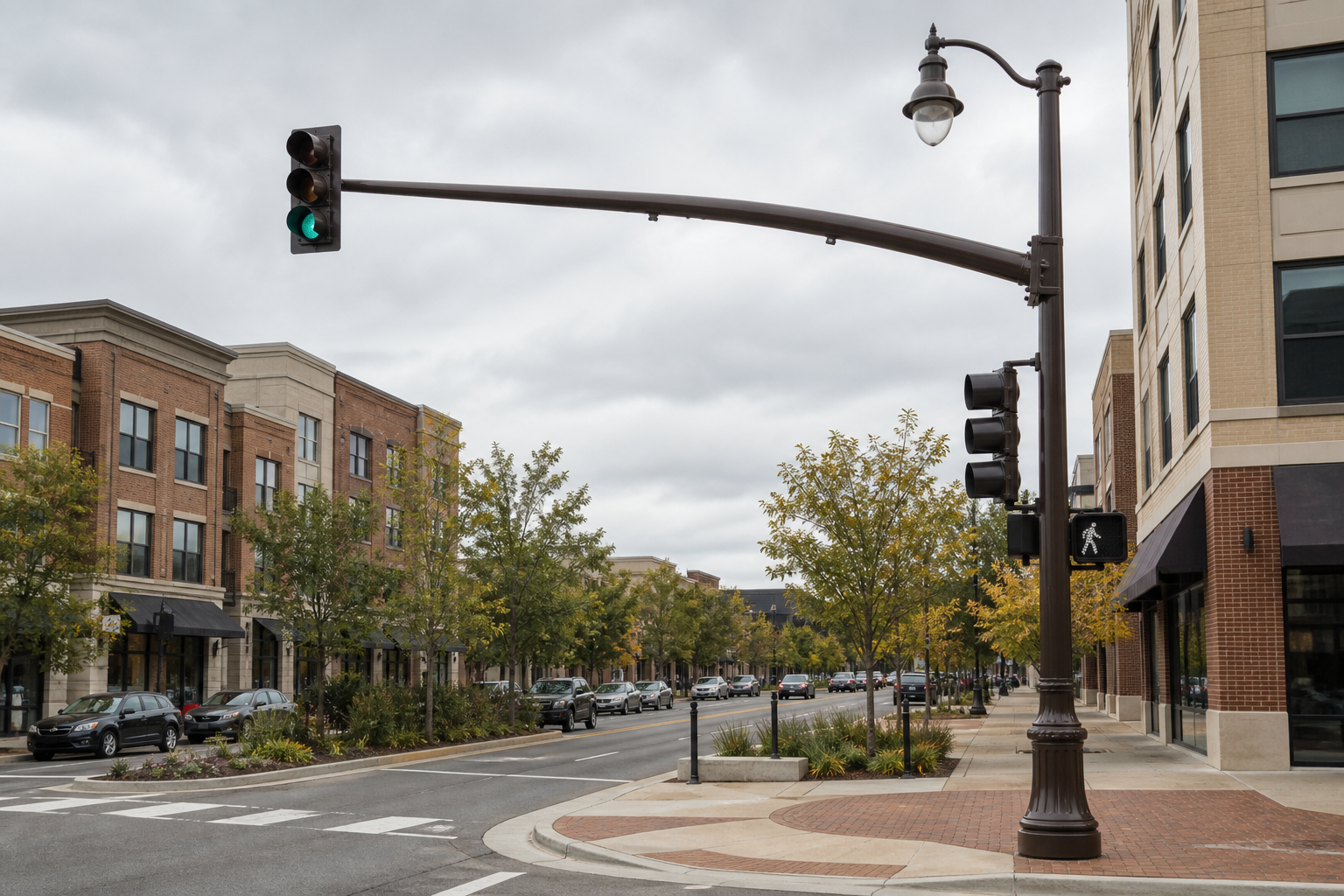
B2B streetscape procurement guide
Decorative Traffic Signal Poles: RFQ Inputs for Streetscape Intersections
Short answer: a decorative traffic signal pole should be priced from the current project package as a coordinated streetscape assembly—not from a silhouette, a finish sample, or a mast-arm length in isolation. The useful RFQ separates confirmed signal, lighting, civil and authority interfaces from the items that still need review.

A decorative intersection is often the point where a municipality wants a recognizable public-realm finish while the project team still has to solve ordinary signal, lighting, accessibility, conduit and construction questions. That mix makes the buying decision more exacting than it looks. A bronze or painted pole family may need to coordinate with a mast arm, signal heads, pedestrian equipment, a luminaire, base details and the surrounding paving. The purchase order is stronger when its technical boundaries are visible before the fabrication release.
This guide is for project owners, contractors, consultants and procurement teams preparing a B2B RFQ. It does not set a universal structural, electrical, foundation or authority requirement. Those requirements belong to the responsible project parties and the applicable jurisdiction. It explains the information that allows a pole supplier to return a comparable, traceable quotation.
The visual family is only one part of the assembly
“Decorative” describes the streetscape intent; it does not close the engineering interface. The same family can be used for a simple pedestrian-scale lighting pole, a traffic-signal pedestal, or a larger mast-arm assembly. Those uses can carry very different attachments, cable paths, access requirements and review conditions. Begin by identifying the physical role of each location: signal support, pedestrian signal support, lighting support, combination support, or a coordinated but separately supplied item.
The first release should also identify whether the chosen finish applies to the shaft, mast arm, brackets, hardware covers and base treatment. A finish direction without a location-specific schedule can leave suppliers quoting different visual scopes. Use a plan reference, a finish sample reference and a note about whether the work must match an existing district family.
Start with the issued plan set, not a catalogue image
A catalogue image can help establish appearance, but it cannot settle the governing project interface. The current plan set, signal schedule, luminaire schedule and authority notes are more useful. Texas DOT’s decorative traffic-signal-pole specification is an example of an agency document that ties a decorative assembly to plans, submittals and installation scope rather than treating it as a standalone product. Arizona DOT maintains a signals-and-lighting drawing index; it illustrates how a jurisdiction can distribute related details across many drawings. These are jurisdiction-specific references, not a substitute for the requirements on a buyer’s own project.
For an RFQ, label the document issue date and distinguish issued details from placeholders. If a plan says “match district standard” but no current standard is attached, say so plainly. A supplier can then price a controlled provisional path or request the missing document, rather than assuming a family, attachment or mounting arrangement.
Build the RFQ around interfaces that change the quote
The table below is deliberately practical. It does not prescribe values; it makes the confirmation path visible. A complete response should show which party owns each open item and how it affects the quotation.
| RFQ input | Why it matters | Confirming party | Quotation treatment |
|---|---|---|---|
| Intersection plan and pole schedule | Links each pole to a location, quantity and role. | Engineer or contractor | Price by scheduled location; list unresolved locations. |
| Signal, pedestrian and luminaire arrangement | Defines supplied attachments and interface points. | Signal designer / authority | Include only confirmed components; flag pending hardware. |
| Mast-arm and bracket information | Controls the supplied configuration and coordination review. | Responsible structural/signal party | Reference the issued detail, not an assumed geometry. |
| Finish and district matching intent | Prevents a visual-scope mismatch across pole, arm and accessories. | Owner, architect or authority | State the specified finish and exclusions explicitly. |
| Base, conduit and foundation interface | Separates supplied pole-side information from civil work. | Civil / electrical / structural parties | Identify known interfaces and exclude unconfirmed civil design. |
| Submittal and acceptance route | Sets review timing and document responsibility. | Contractor / authority | Show drawings, samples and review assumptions. |
Useful context can also be found on the project’s own engineering support path. The purpose is not to transfer design responsibility to the supplier; it is to make the RFQ readable enough for the supplier to identify what can be proposed and what still needs the project team’s decision.
Scenario one: the district standard is confirmed
Example: a downtown reconstruction package includes a current district pole schedule, locations, issued traffic-signal details, an approved finish sample and a clear list of supplied signal hardware. The contractor needs a quotation for the pole assemblies and coordinated submittals. In this case, the RFQ can reference the exact drawing revisions, quantity by location, finish schedule and required review sequence. The quote should still make it clear whether control equipment, conduit, foundations, installation and traffic control belong to other scopes.
The commercial advantage is comparability. When every bidder receives the same equipment and interface record, the procurement team can compare delivery assumptions, supplied accessories, documentation and exceptions rather than trying to reconcile a different interpretation of the streetscape concept.
Scenario two: the appearance is approved but the interfaces remain open
Example: a redevelopment team has approved a visual concept and pole family but the latest signal-head arrangement, pedestrian devices and final utility route are still under coordination. The right response is not to silently convert those unknowns into a fixed configuration. The RFQ can request a preliminary commercial proposal tied to the available concept package, with an open-items register: final attachments, authority detail, base/foundation responsibility, cable-entry requirements and release date.
This creates a disciplined change-control path. It gives the buyer a budgetary procurement view while preserving the need for responsible parties to close the outstanding engineering and authority details. The supplier’s drawing review can then compare a proposed supplied configuration against the final provided inputs; it does not replace civil, electrical, structural or authority approval.
Compare suppliers by scope, documentation and exceptions
A lower-looking line item can be a different scope. Compare the supplied pole, mast arm, decorative components, signal/luminaire interfaces, access provisions, finish, anchor or base information, samples, drawings, packaging and delivery assumptions. Ask every supplier to list assumptions in the same order as the RFQ table. That makes omissions visible and helps the team avoid treating a pending civil or electrical item as though it were included in the pole supply.
For product-family context, buyers can review the site’s light-pole product families and the Knowledge Center. Those pages are starting points for discussion, not an override of issued project documents. The procurement record should always identify the applicable project layout and responsible reviewers.
Use a release sequence that protects the programme
The release sequence below keeps a real project moving without pretending that open information is final. It also gives a purchasing team a clear checkpoint before fabrication.
| Stage | What the project provides | What the supplier can return | Release condition |
|---|---|---|---|
| RFQ issue | Current drawings, quantities, visual intent and known interfaces. | Comparable commercial scope, assumptions and questions. | Open items recorded. |
| Technical alignment | Clarifications from responsible project parties. | Proposed supplied configuration against supplied inputs. | Exceptions resolved or controlled. |
| Submittal review | Required review path and final attachments/details. | Drawing/sample package in the agreed scope. | Responsible reviewers confirm acceptance path. |
| Fabrication release | Approved release information and change-control owner. | Production schedule for agreed supplied items. | No unresolved item is mistaken for approval. |
| Delivery coordination | Site sequence, unloading and installation interfaces. | Packing and delivery information for pole supply. | Civil, electrical and installation scopes remain assigned. |
The City of Columbus traffic-signal construction drawings provide another public example of how detailed signal-pole and pedestal information can be embedded in a local standard set. A project outside that jurisdiction should use its own authority’s documents, not transplant the drawing as a universal requirement.
What to send before requesting a quotation
Send the latest plan set and drawing register, quantities by location, signal and luminaire schedule, known attachment information, finish intent, project location, required delivery window, responsible review party and any known base, conduit or cable-entry notes. State whether the supplier is pricing pole-side supply only or a larger agreed package. If the project is still resolving interfaces, list them as pending and identify who will close them. This is faster and safer than asking a supplier to reverse-engineer a streetscape assembly from one rendering.
When the package is ready, use the RFQ form to provide the project documents and the review stage. Fortune Light Pole can discuss a proposed supplied configuration against the inputs provided, identify commercial clarification items and prepare a quote for the agreed supply scope. The project’s responsible parties retain confirmation of civil, electrical, structural, installation and authority requirements.
Frequently asked questions
What should be sent with a decorative traffic signal pole RFQ?
Send the current intersection plan, pole schedule, signal and luminaire arrangement, known mast-arm and pedestrian-device details, finish intent, quantity, utility/control interfaces, review authority and the latest issue status. A supplier can identify missing commercial inputs, but the responsible project parties confirm the final technical and authority requirements.
Can a supplier price the pole before every detail is closed?
Yes, when the quotation clearly separates confirmed supplied items from allowances, exclusions and items pending the authority or engineer review. The record should identify what may change instead of implying that an open drawing has been finalized.
Is a decorative pole a standard roadway-lighting pole with a different finish?
Not automatically. The visual family, signal hardware, luminaire, mast-arm geometry, base interface, cabinet or conduit coordination and jurisdictional details may all differ. Treat it as a coordinated assembly and compare like-for-like scope.
Next step: prepare a controlled decorative-pole RFQ
Send the current intersection package
Include the layout, quantities, signal and lighting information, finish direction, known interfaces and required review stage. We will return questions and a proposal scope that separates confirmed supply from pending project decisions.
Primary sources
- Texas DOT Special Specification 8044: Decorative Traffic Signal Pole with Luminaire (jurisdiction-specific example).
- Arizona DOT Signals and Lighting Standard Drawings (jurisdiction-specific drawing index).
- City of Columbus Traffic Signal Standard Construction Drawings (local standard-drawing example).
Leave a Reply