Verified industry update · July 2026
CDOT’s July 2026 Roadway-Lighting Plans: RFQ Inputs Buyers Should Recheck
Colorado DOT lists a July 1, 2026 edition of its S-Standard Plans, including Roadway Lighting and Alternative Roadway Lighting. The release is a state-specific reference, not a universal product specification. Its practical value for a light-pole RFQ is a reminder to make control, foundation, raceway and responsibility interfaces explicit before a supplier prices a configuration.

What the release confirms
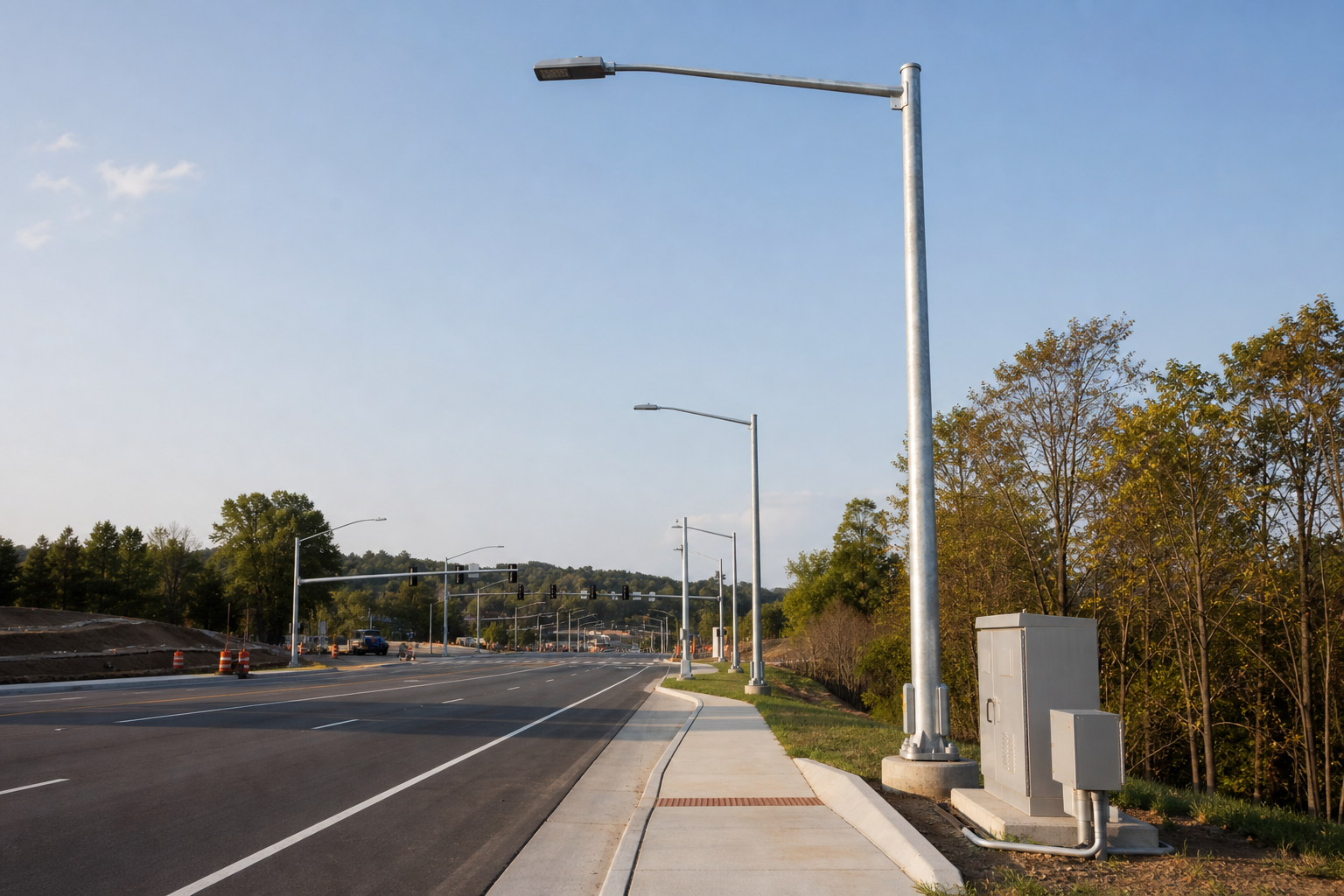
CDOT identifies July 1, 2026 as the latest published S-Standard set and lists S-613-1 Roadway Lighting and S-613-2 Alternative Roadway Lighting. The S-613-2 sheet shows that a roadway-lighting package can reach well beyond a shaft and luminaire: it references a lighting control center, enclosure, surge protection, terminal capacity, raceways, grounding and project-directed details.
Why this matters before an RFQ
A buyer can request a pole, bracket and finish while leaving the electrical and civil interfaces unresolved. That may produce quotations that look comparable but allocate cabinets, conduits, base details, controls and review responsibilities differently. Use the current owner or authority drawings as the governing document and show the supplier which interfaces are included, supplied by others or still open.
RFQ checklist prompted by the standard-plan update
Attach the current plan and pole schedule; identify the drawing issue and jurisdiction; state the luminaire and mounting interface; identify the base or direct-burial direction, finished grade and cable entry; identify any lighting-control-center, cabinet, photocell/node, surge-protection, raceway and grounding requirements; then define scope boundaries and the drawing-review route. A supplier should not infer a local standard detail from a general project location.
What not to infer
A Colorado standard plan does not automatically govern another state, municipality, export market or privately owned site. It also does not by itself establish pole height, structural capacity, wind design, luminaire mass/projected area, foundation design, conductor sizing, installation method or final authority approval. Those items remain project-specific and must be confirmed by the responsible parties.
Commercial takeaway
For roadway projects, ask for a proposal that separates the proposed pole assembly from owner-furnished equipment and unresolved civil or electrical items. This produces a cleaner quote, a more reviewable shop-drawing package and fewer late changes to base details, access provisions or cabinet interfaces.
Primary sources
FAQ
Is S-613-2 a universal roadway-lighting specification?
No. It is a CDOT standard-plan reference. Apply the current project and authority requirements, not a copied assumption.
What should be sent with a roadway-lighting RFQ?
Send the latest layout, quantities, pole locations, luminaire and mounting information, known base/cable/control interfaces, material or finish direction, scope boundaries and review path.
Can a pole supplier finalize the electrical or civil design?
The responsible project parties must confirm electrical, civil, structural, installation and authority requirements. A supplier can discuss a proposed supplied configuration against the provided inputs.
Prepare a clearer roadway-lighting RFQ
Send the latest plan, pole locations and quantities, luminaire/mounting data, control and cabinet status, known base/cable interfaces, finish direction, scope boundaries and the required review stage.
Open RFQ Form
Leave a Reply